KYC/AML Automation: The Checkpoint Playbook for African Fintech
The trigger-limit blind spot
In April 2024, roughly ₦11 billion (about $7 million) moved out of Flutterwave into accounts across five financial institutions in four days. An insider later put the real figure at ₦20 billion or more. Court documents and TechCabal’s reporting describe how it stayed undetected: the deposits were kept below the limits that would trigger fraud checks (Techpoint Africa, TechCabal). The monitoring system was not broken — it was looking for the wrong thing.
The core lesson A rule that fires only when a single transaction crosses a threshold is a checklist, not a control. Attackers read the checklist. Automation is only as good as the number of independent checkpoints behind it.
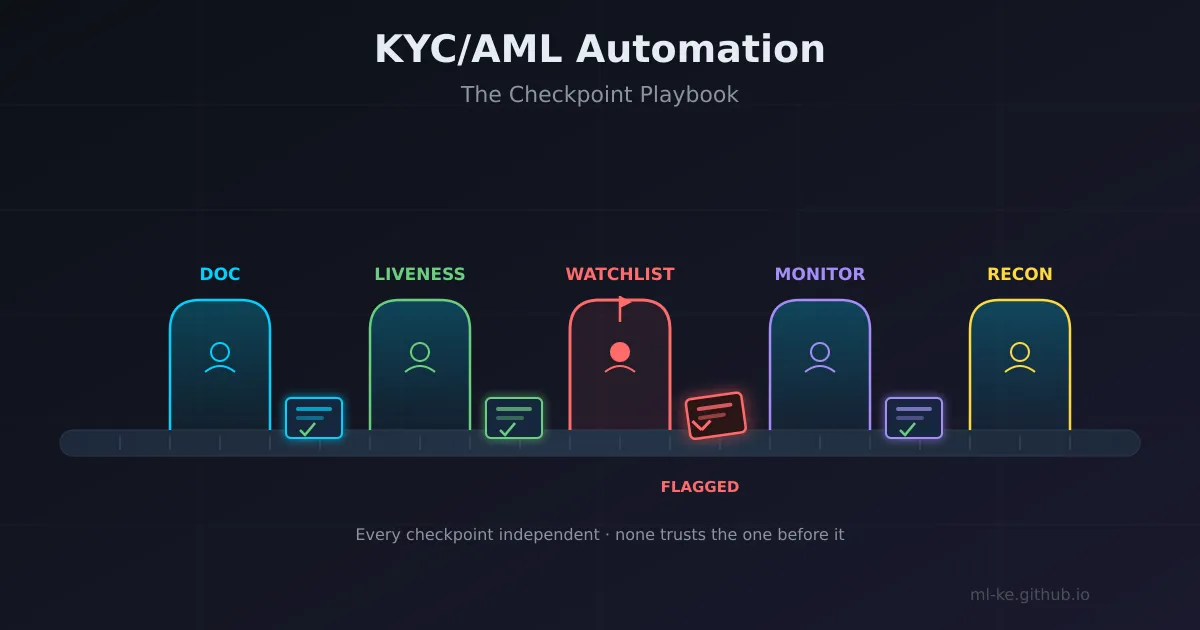
This is the Sunday playbook for the Flutterwave anatomy, NCBA ghost accounts, and deepfake fraud we covered this week: five automated checkpoints that catch the fraud those incidents demonstrated.
The five-checkpoint pipeline
| # | Checkpoint | Catches | Incident it answers |
|---|---|---|---|
| 1 | Identity verification (document + liveness) | Synthetic and injected identities | Group-IB’s 8,065 KYC injection attempts |
| 2 | Watchlist screening with entity resolution | Name-variant laundering, PEPs, sanctions | Mule accounts in 27 banks |
| 3 | Transaction monitoring that sees accumulation | Threshold-bypass structuring | Flutterwave’s below-limit deposits |
| 4 | Access and insider controls | Ghost accounts, rogue contractors | NCBA’s 70-account fraud |
| 5 | Daily reconciliation control totals | Anything the monitors missed | NCBA caught by EOW reconciliation |
Checkpoint 1 — identity verification that assumes attackers have AI
Group-IB documented 8,065 injection attempts against a single financial institution’s KYC liveness check for digital loan onboarding between January and August 2025, and found 2,000+ deepfake creation tools, dozens built specifically to bypass KYC (Biometric Update, Group-IB). In Kenya, deepfakes already account for roughly 10% of fraud attempts (Businessday NG). Automated onboarding must therefore treat every selfie as potentially synthetic: liveness checks with presentation-attack detection, document cross-checks (MRZ parsing, hologram features), and device/behavioural signals — not a single “face matches ID” pass.
Checkpoint 2 — screening with entity resolution, not exact match
Flutterwave’s February 2023 incident spread ₦2.9 billion across 107 accounts in 27 banks (TechCabal, TechCrunch). Mule networks are built on slight name variations, shared phone numbers, and reused addresses. Exact-string watchlist matching misses them. Automated screening should tokenize and fuzzy-match names, cluster shared identifiers, and link accounts across wallets and mobile-money rails into a single entity graph — the same technique that flags a “new” customer who shares a phone with a sanctioned entity.
Checkpoint 3 — monitoring that sees accumulation
The April 2024 Flutterwave loss is the canonical failure of threshold-only monitoring. The fix is velocity and accumulation logic: monitor sums over sliding windows, not just single transactions. A minimal detector:
1
2
3
4
5
6
7
8
9
10
11
12
13
14
import pandas as pd

def flag_accumulation(txns, window_h=24, threshold=1_000_000, min_count=3):
    """Flag accounts where many small deposits accumulate past a threshold
    within a sliding window — the 'below trigger limits' pattern."""
    txns = txns.sort_values("ts")
    flagged = []
    for acct, g in txns.groupby("account"):
        rolling = g.set_index("ts")["amount"].rolling(
            f"{window_h}h", min_periods=min_count
        ).sum()
        hits = g[rolling >= threshold]
        flagged.extend(hits.index.tolist())
    return flagged
This is exactly the pattern Danske Bank’s Estonian branch taught at scale — and the fix that works. Teradata’s published case study on Danske shows rules caught only ~40% of suspicious activity while generating ~1,200 false positives per day; the ML-assisted system cut false positives by ~50% and raised detection to ~60% (Teradata, Fintech Futures). Layered monitoring — rules for known patterns, ML for anomalies, graph analytics for rings — is the automation that catches what thresholds miss.
Checkpoint 4 — access and insider controls
In June 2025, a contractor with live backend access at NCBA Bank Rwanda created 70 ghost accounts and moved Ksh 57.5 million in 260 transactions (kenyainsights.com, Business Daily). The accounts were opened inside the bank’s own systems — no KYC pipeline can stop an attacker who already holds the keys. The automation that matters here is just-in-time access: no standing production credentials, automated access reviews, anomaly alerts when a single operator creates accounts at abnormal velocity, and dual control for account creation. KYC automation is only as strong as the identity layer around the people who run it.
Checkpoint 5 — reconciliation as the final backstop
NCBA was ultimately caught by reconciliation — investigators traced the ghost-account transactions after the fact, and the anomaly only surfaced because ledgers were compared. Every automated control eventually fails; the backstop is daily control totals: sum of accounts created, sum of debits, sum of credits, per system, compared across source and destination ledgers. Automated break detection turns “we noticed months later” into “flagged at next morning’s run” — the same discipline covered in reconciliation analytics.
How we can do better
| Control | Automation | Failure mode it closes |
|---|---|---|
| Layered liveness + document checks | Presentation-attack detection, behavioural signals | Deepfake KYC injection (8,065 attempts) |
| Entity-resolution screening | Fuzzy match, shared-identifier clustering | Mule networks across banks |
| Sliding-window velocity + ML anomaly | Accumulation flags, FP reduction | Threshold-bypass structuring (₦11B) |
| JIT access + dual control | Automated reviews, velocity alerts | Insider ghost accounts (Ksh 57.5M) |
| Daily control totals | Automated break detection | Silent drift between ledgers |
The through-line: every incident this week was defeated not by a smarter single check but by the absence of the next check. Build the pipeline — each checkpoint automated, each independently triggered, none trusting the one before it. That is the playbook.
References
- TechCabal — How Flutterwave lost ₦11bn in 4 days
- Techpoint Africa — Flutterwave ₦11bn insider account
- TechCabal — Hundreds of accounts frozen (Feb 2023)
- TechCrunch — Flutterwave breach allegations (Mar 2023)
- Biometric Update — Group-IB: 8,065 KYC injection attempts
- Group-IB — Weaponized AI report
- Businessday NG — Deepfake fraud surges across Africa
- Teradata — Danske Bank case study
- Fintech Futures — Danske Bank ML monitoring
- kenyainsights.com — NCBA Rwanda insider fraud
- Business Daily — NCBA ghost accounts