vLLM and High-Throughput LLM Serving: PagedAttention and Continuous Batching
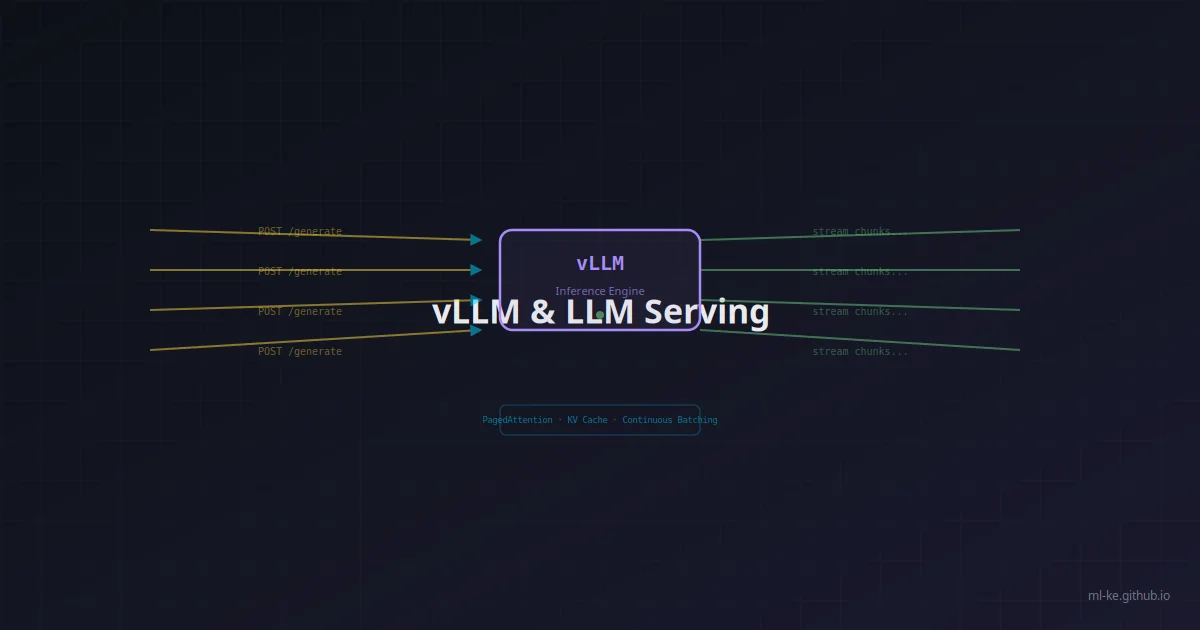
Serving large language models (LLMs) at scale is fundamentally different from serving classical ML models. An LLM inference request doesn’t just produce a single output — it runs an autoregressive loop that generates tokens one at a time, with each step consuming GPU memory for the key-value (KV) cache. This memory overhead is the primary bottleneck.
Enter vLLM: the most popular open-source LLM serving engine, used by companies like OpenAI, Databricks, and Anthropic in production. It achieves state-of-the-art throughput through two key innovations: PagedAttention and continuous batching.
The KV Cache Problem
When an LLM generates text, every attention layer computes keys and values for each token in the sequence. These are cached for reuse across generation steps — known as the KV cache. For a 70B parameter model, a single 4096-token sequence can consume over 40 GB of GPU memory just for the KV cache.
Traditional serving systems pre-allocate contiguous memory blocks for each request’s KV cache. This leads to severe memory fragmentation — like a file system that allocates files in fixed-size blocks without paging. When a request finishes or a new one arrives, the freed memory is often in small, non-contiguous chunks that can’t be reused.
PagedAttention: Solving KV Cache Fragmentation
PagedAttention, introduced in the vLLM paper (Kwon et al., 2023), takes inspiration from virtual memory in operating systems. Instead of allocating contiguous memory for each request’s KV cache, it divides the cache into fixed-size blocks (pages) and maintains a page table mapping logical blocks to physical memory locations.
Here’s how it works:
1
2
3
4
5
6
7
8
Without PagedAttention (Contiguous):
|  Request A (full block)  |    Free    |  Request B (full block)  |
|    20 GB contiguous      |  10 GB     |     15 GB contiguous     |

With PagedAttention (Paged):
| A0 | B0 | C0 | A1 | Free | B1 | C1 | A2 | Free | Free |
| 4KB blocks of KV cache, non-contiguous per request
| Page Table: A → [0, 3, 7], B → [1, 5], C → [2, 6]
The benefits are dramatic:
- Near-zero memory waste from fragmentation
- Shared prefixes: when multiple requests share a prompt prefix (e.g., system prompt), PagedAttention can share those KV cache blocks across requests
- Copy-on-write: efficient handling of beam search and parallel sampling
- Memory overselling: you can accept more concurrent requests than fit in GPU memory, swapping cold blocks to CPU
Continuous Batching: Never Leave the GPU Idle
Traditional request batching works like a bus — you wait for a full batch to arrive, run them all together, and return results. But LLM generation has highly variable completion times. A request generating 10 tokens finishes much faster than one generating 1000 tokens.
Continuous batching (also called in-flight batching or iteration-level scheduling) solves this by re-evaluating the batch at every decoding step. When a request finishes, it’s immediately removed and a new request is added to the batch, keeping the GPU fully utilized.
1
2
3
4
5
6
7
8
9
10
11
12
13
14
15
16
17
18
19
20
21
22
23
24
25
26
27
# Simplified illustration of continuous batching
class ContinuousBatchingScheduler:
    def __init__(self, max_batch_size=64):
        self.running = []      # Requests currently being processed
        self.waiting = deque()  # Requests waiting to start
        self.max_batch_size = max_batch_size

    def step(self):
        """One iteration of the decoding loop."""
        # Remove finished requests
        self.running = [r for r in self.running if not r.finished]

        # Add waiting requests up to max batch size
        while len(self.running) < self.max_batch_size and self.waiting:
            self.running.append(self.waiting.popleft())

        if not self.running:
            return

        # Batch decode — run one step for all active requests
        inputs = torch.cat([r.last_token for r in self.running])
        outputs = self.model(inputs)

        # Distribute outputs to individual requests
        for i, req in enumerate(self.running):
            next_token = outputs[i].argmax(dim=-1)
            req.append_token(next_token)
Setting Up vLLM
vLLM provides an OpenAI-compatible API server, making it drop-in replaceable with OpenAI’s API for compatible clients.
Installation
1
pip install vllm
Serving a Model
1
2
3
4
5
6
7
# Serve Meta Llama 3.1 8B
python -m vllm.entrypoints.openai.api_server \
    --model meta-llama/Meta-Llama-3.1-8B-Instruct \
    --tensor-parallel-size 2 \
    --max-model-len 8192 \
    --gpu-memory-utilization 0.90 \
    --dtype auto
1
2
3
4
5
# With quantization (AWQ quantized model)
python -m vllm.entrypoints.openai.api_server \
    --model TheBloke/Llama-2-7B-Chat-AWQ \
    --quantization awq \
    --max-model-len 4096
Key parameters explained:
| Parameter | Purpose | Recommended |
|---|---|---|
--tensor-parallel-size | Split model across N GPUs | Set to number of GPUs |
--max-model-len | Maximum context window | Match model’s max, or lower to save memory |
--gpu-memory-utilization | Fraction of GPU memory for KV cache | 0.85–0.95 |
--dtype | Model precision (auto/half/float16/bfloat16) | auto or bfloat16 |
--quantization | Quantization method (awq/gptq/squeezellm) | Use quantized models for large models |
--max-num-seqs | Max concurrent sequences | Start at 256, tune up |
--enable-prefix-caching | Cache shared prompt prefixes | Enable for chatbots with system prompts |
Quantization: Fitting Big Models on Fewer GPUs
LLMs are typically trained in 16-bit (float16 or bfloat16), requiring 2 bytes per parameter. A 70B model at 16-bit takes ~140 GB of GPU memory — too large for a single A100 (80 GB). Quantization reduces precision while preserving quality.
AWQ (Activation-aware Weight Quantization)
AWQ analyzes the model weights and identifies the 1% most “important” weights that disproportionately affect output quality. It keeps those in higher precision while aggressively quantizing the rest.
1
2
3
4
5
# Serve an AWQ-quantized model
python -m vllm.entrypoints.openai.api_server \
    --model casperhansen/mixtral-instruct-awq \
    --quantization awq \
    --max-model-len 8192
GPTQ (Post-Training Quantization)
GPTQ uses approximate second-order information to find optimal quantization points. It’s slightly slower at serving than AWQ but achieves comparable quality.
Memory Comparison
| Model | FP16 | AWQ 4-bit | GPTQ 4-bit | GGUF (CPU) |
|---|---|---|---|---|
| Llama 3.1 8B | 16 GB | 5 GB | 5 GB | 4.5 GB |
| Llama 3.1 70B | 140 GB | 40 GB | 40 GB | 35 GB |
| Mixtral 8x22B | 280 GB | 80 GB | 80 GB | 70 GB |
OpenAI-Compatible API
Once vLLM is running, you can use the standard OpenAI Python client:
1
2
3
4
5
6
7
8
9
10
11
12
13
14
15
16
17
18
19
from openai import OpenAI

client = OpenAI(
    base_url="http://localhost:8000/v1",
    api_key="not-needed",  # vLLM doesn't auth by default
)

# Chat completion
response = client.chat.completions.create(
    model="meta-llama/Meta-Llama-3.1-8B-Instruct",
    messages=[
        {"role": "system", "content": "You are a helpful assistant."},
        {"role": "user", "content": "Explain PagedAttention in three sentences."},
    ],
    temperature=0.7,
    max_tokens=512,
)

print(response.choices[0].message.content)
This API compatibility means any tool that works with OpenAI (LangChain, LlamaIndex, etc.) also works with vLLM — just change the base_url.
Benchmarking vLLM Performance
Here’s a quick benchmark setup using the built-in benchmarking scripts:
1
2
3
4
5
6
7
8
9
10
11
12
# Clone vLLM for benchmark scripts
git clone https://github.com/vllm-project/vllm
cd vllm/benchmarks

# Benchmark throughput
python benchmark_throughput.py \
    --model meta-llama/Meta-Llama-3.1-8B-Instruct \
    --backend vllm \
    --input-len 512 \
    --output-len 256 \
    --num-prompts 1000 \
    --num-scheduler-steps 10
Typical results (on 1x A100 80 GB with Llama 3.1 8B):
| Config | Throughput (tokens/s) | Latency P50 | Latency P99 |
|---|---|---|---|
| Batch=1, no continuous batching | ~120 | 120ms | 180ms |
| Batch=64, continuous batching | ~2,800 | 320ms | 850ms |
| Batch=256, continuous batching | ~3,500 | 950ms | 2.1s |
Performance Tuning Tips
Set
--max-model-lenlower than the model’s maximum if your use case doesn’t need long contexts. Shorter context = smaller KV cache = more concurrent requests.Use
--gpu-memory-utilization 0.90leaving 10% for model weights, CUDA overhead, and scratch memory.Enable prefix caching (
--enable-prefix-caching) if your requests share a system prompt — vLLM will share KV cache blocks across all requests.Tune
--max-num-seqs— too low underutilizes the GPU, too high causes OOM. Start at 256 and increase until you hit memory limits.Use
bfloat16on Ampere and newer GPUs — it’s more numerically stable than float16 and avoids the overflow issues that can cause NaN outputs.Consider tensor parallelism for models that don’t fit on one GPU —
--tensor-parallel-size 2splits the model across 2 GPUs with minimal overhead (<5%).
When vLLM Is and Isn’t the Right Choice
Use vLLM when:
- You’re serving decoder-only transformer models (Llama, Mistral, Qwen, etc.)
- You need high throughput with many concurrent users
- You want OpenAI API compatibility
- You have GPU resources (A100, H100, or high-end consumer GPUs)
Consider alternatives when:
- Your model isn’t a standard transformer (use TensorRT-LLM or TGI)
- You need CPU inference (use llama.cpp with GGUF)
- You’re running on very limited hardware (use Ollama with quantization)
- You need custom model parallelism beyond tensor parallelism (use DeepSpeed)
Next Steps
vLLM handles the serving layer, but production requires orchestration, monitoring, and scaling. In the next post, we’ll dive into GPU optimization — understanding CUDA memory management, parallelism strategies, and profiling tools to get the most out of your hardware.