Small AI by design: ten Kenyan startups and the offline-first constraint
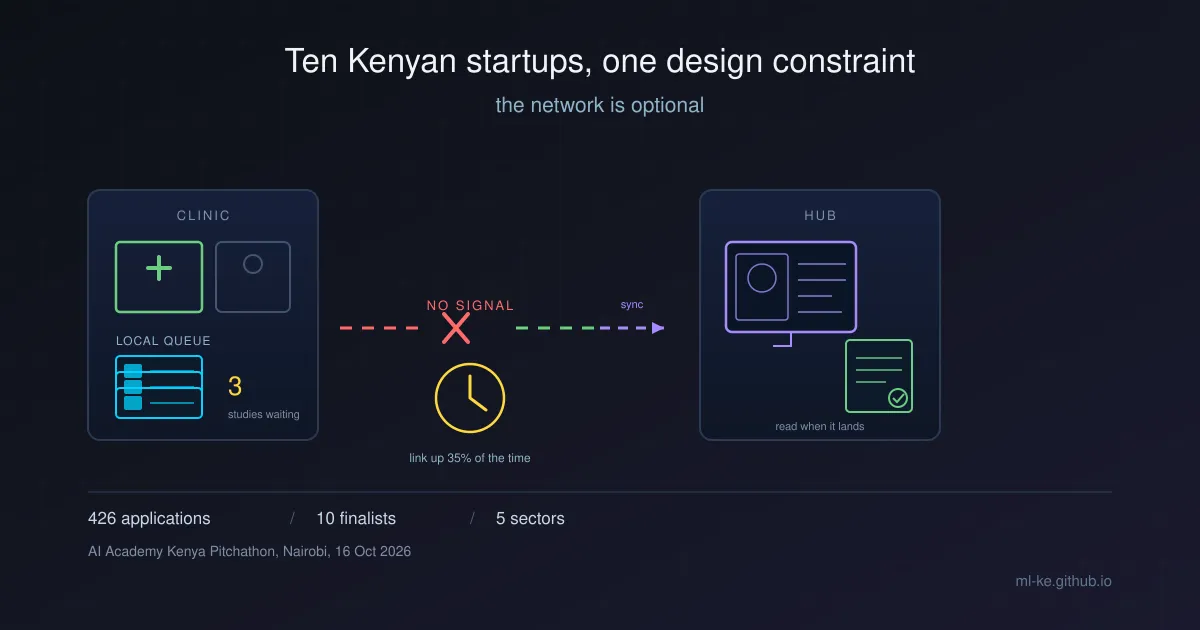
Ten teams, one shared design constraint On 16 October 2026, Meta and the Nairobi accelerator This Is Digital ran the first AI Academy Kenya Pitchathon. Ten finalists were picked from 426 applications, and two went home with US$5,000 each in equity-free funding. Read the product list and a pattern appears that has little to do with model choice: almost every entry is designed for a place where the network, the grid or the language is not guaranteed.
The winners were Neural Labs Africa, with a tele-radiology platform called NeuralSight, and Me-Nasoma, which turns documents and web pages into audio in local languages. Both were named in Nairobi on 16 October, and both were invited to pitch at Meta’s Regional AI Summit in Istanbul on 24 November 2026 (Capital FM, The Standard).
That is a small cheque and a small event. What makes it worth a post is the cohort behind it: ten products, described in enough detail to see the engineering decisions, pitched to judges from Meta, the State Department of ICT, Strathmore’s iLab Africa and a local accelerator. It is an unusually concrete look at what “small AI” means when it is built by people who live with the constraints.
What happened at the pitchathon
The pitchathon ran at The Social House in Lavington, Nairobi, on Friday 16 October, and doubled as the launch of a partnership between Meta and This Is Digital, an accelerator that advises African enterprises on AI strategy and adoption (TechMoran, TechTrends KE).
- 426 applications produced 10 finalists, spread across healthcare, education and assistive technology, retail and commerce, legal services, and finance and tax compliance.
- Applications came from startups and independent developers building products or prototypes on Meta’s open models and tools (Business Tech Africa).
- Each winner received US$5,000, about KSh 645,000, plus Meta advertising credits. The combined prize pool was KSh 1.3 million.
- Two pitching rounds were judged by Chinny Francis (Meta, policy programmes for AI and wearables), Gregory Wanjama (This Is Digital), Isaac Hunja (Kaara Works), Evan Gichuki (State Department of ICT and Digital Economy) and Nathasha Nalyaka (Strathmore University iLab Africa).
The framing from the organisers was explicitly local. “Our partnership with the government and local ecosystem partners is helping expand access to AI skills, tools and opportunities in Kenya,” said Sarah Muyonga, Meta’s public policy manager for East and Horn of Africa. Chinny Francis described the academy’s approach as working with partners who know local markets, rather than importing solutions (Capital FM).
The ten products, and the constraint each one answers
Sort the cohort by constraint rather than by company and the shape of the market shows up.
| Startup | Product | Constraint it is built around |
|---|---|---|
| Neural Labs Africa | NeuralSight, AI-assisted tele-radiology and diagnostic reporting | No radiologist on site, and no reliable link to one |
| Me-Nasoma | Documents and web pages converted to audio, mobile, web and browser extension | Readers blocked by cost, print, bandwidth or literacy |
| Solivia Data | AfyaEdge, solar-powered offline triage hubs | Power and connectivity, together |
| O.C.A. | Claims auditing for insurers meeting Social Health Authority rules | Claims workflow that has to run before submission, not after |
| Utter Africa | Kiswahili-first augmentative and alternative communication for non-verbal children with autism | No local-language AAC vocabulary to borrow |
| Jackfruit Network | Data-driven advisory for low-fee private schools | Decisions made without data systems |
| TemboTrade | AI commerce and resource planning for small businesses | Stock, orders and books kept in separate places |
| JuaFlow | Workflow automation linking customer messages to business systems | Sales that start in a chat app and never reach a record |
| HakiChain | Legal drafting grounded in African statutes with citations | Imported legal AI that cites the wrong jurisdiction |
| Sawazisha AI (John Digital Solutions) | WhatsApp assistant matching transactions to KRA eTIMS invoices | Compliance work done by hand, on a phone |
Sources for the cohort descriptions: TechMoran, TechTrends KE, Business Tech Africa.
Six of the ten sit in health and education. That is not a coincidence of taste. Those are the two sectors where a Kenyan institution already pays for a service, and where the alternative to software is a queue. A private school with 300 pupils and a clinic with two nurses both have a measurable cost for delay, which makes them reachable customers for a tool that saves time even when it is imperfect.
Power is the second constraint, and it shows up in the cohort’s hardware choices. Solivia Data pairs its triage hub with solar, which reads as a supply-chain footnote until you consider what it implies: a device that draws a few watts can run from a panel and a battery, while a device that assumes mains power assumes a grid connection the facility may not have. For a builder, that converts into a hard budget on model size. An on-device classifier that fits in a few hundred megabytes and runs a handful of images per minute on a mid-range phone behaves very differently from a pipeline that calls an API for every frame. The trade is familiar: a smaller model, a narrower task and a quantised runtime in exchange for working at all during a power cut and a dead link at the same time.
The two winners, and the shape of the decisions
Neural Labs Africa, led by Tom Kinyanjui, won with NeuralSight: a platform that connects health facilities to remote specialists and supports diagnostic reporting, explicitly designed for areas with limited internet connectivity. Me-Nasoma, led by Oscar Karuga, won with a document-to-audio service delivered through a mobile app, the web and a Chrome extension, aimed at learners and professionals who cannot easily read what they need in print (The Standard).
Both are distribution decisions dressed as feature decisions. A radiologist in Nairobi is no use to a clinic whose link drops at 11:00, so the product has to say what happens during the gap: does the study wait on a phone, does a thumbnail go first, does the report arrive tomorrow? Me-Nasoma’s choice of a Chrome extension alongside an app is the same kind of thinking. Browser extensions reach shared desktops in schools and offices without an install flow, and audio output removes the need for a screen at all.
The honest caveat came from Capital FM’s own write-up: the award’s longer-term effect depends on whether the winners convert funding and exposure into sustainable businesses, and NeuralSight’s reliance on remote specialists raises open questions about connectivity, integration with existing health systems and affordability. Five thousand dollars buys a few weeks of runway, not a market. What it does buy is a place on stage in Istanbul on 24 November, in front of a regional audience.
Why the offline case keeps winning
The World Bank’s digital strategy, launched in Seoul on 20 October 2026 alongside the AI Infrastructure and Readiness Initiative, put numbers to the constraint these teams design around: more than 2 billion people were offline in 2025, and internet use in low-income countries stood at 23%, against 94% in high-income countries (billionaires.africa). The same announcement noted about 1.2 billion young people reaching working age over the next 10 to 15 years against roughly 420 million expected jobs.
For a builder, that ratio is the argument for task-specific tools over general assistants. A general assistant assumes a session, a screen and a subscription. A task-specific tool can be priced per claim, per report, per lesson, and can be wrapped in the workflow an institution already runs. World Bank president Ajay Banga framed the strategy as “AI for the people”, with an emphasis on small AI tools for local tasks (Techeconomy).
The compute side of that initiative is shared, pay-as-you-go GPU capacity for governments in emerging markets, with Cassava Technologies and Nvidia as knowledge partners and an initial focus on Africa and Latin America. Cassava has said it plans to install 12,000 Nvidia GPUs across its data centres (Business Day). Cheap regional compute changes training and hosting economics for a team like Neural Labs Africa. It does not change the last mile, which is the part this cohort is built around.
What store-and-forward costs you, in hours
The engineering question that matters in this cohort is not which model runs. It is what the product does when the link is down, because a queue policy can dominate every model improvement you will ever ship.
The script below models a district facility sending imaging studies to a hub over a link that is up only part of the time. Outages are clustered in two-hour blocks, which is closer to how a rural link behaves than independent per-minute failure. Three policies send the same 240 referrals over the same 90-day trace:
- nightly: the full study uploads only in the 02:00 window
- retry: the full study uploads at whichever slot has four contiguous online slots
- graded: a compressed thumbnail goes first, needing a single online slot
1
2
3
4
5
6
7
8
9
10
11
12
13
14
15
16
17
18
19
20
21
22
23
24
25
26
27
28
29
30
31
32
33
34
35
36
37
38
39
40
41
42
43
44
45
import random, statistics

SLOT_MIN = 15                  # one upload opportunity every 15 minutes
SLOTS_PER_DAY = 24 * 60 // SLOT_MIN
DAYS = 90
BLOCK = 8                      # 2-hour blocks share one draw, so outages cluster
FULL_STUDY_WINDOW = 4          # contiguous online slots needed to push the full study

def run(p_online, seed=7):
    rng = random.Random(seed)
    slots = []
    for _ in range(DAYS * SLOTS_PER_DAY // BLOCK):
        slots.extend([rng.random() < p_online] * BLOCK)
    slots = slots[: DAYS * SLOTS_PER_DAY]
    arrivals = sorted(rng.randrange(len(slots)) for _ in range(240))

    def wait(start, need, only_hour=None):
        s = start
        while s + need <= len(slots):
            if only_hour is not None and s % SLOTS_PER_DAY != only_hour:
                s += 1
                continue
            if all(slots[s:s + need]):
                return (s - start) * SLOT_MIN / 60
            s += 1
        return None

    out = {}
    for name, need, hour in (("nightly", FULL_STUDY_WINDOW, 8),
                             ("retry", FULL_STUDY_WINDOW, None),
                             ("graded", 1, None)):
        d = sorted(x for x in (wait(a, need, hour) for a in arrivals) if x is not None)
        out[name] = (statistics.median(d), d[int(0.9 * len(d))],
                     100 * sum(1 for x in d if x > 24) / len(d))
    return len(slots), out

print(f"{'link up':>8s}  {'policy':8s}{'median h':>10s}{'p90 h':>8s}{'over 24 h':>11s}")
for p in (0.55, 0.35, 0.20):
    n, res = run(p)
    for name, (med, p90, over) in res.items():
        print(f"{100*p:7.0f}%{name:10s}{med:10.1f}{p90:8.1f}{over:10.0f}%")

_, lo = run(0.35)
print(f"\nat 35% link time the nightly window leaves {lo['nightly'][2]:.0f}% of referrals "
      f"unread past a day; retrying every slot leaves {lo['retry'][2]:.0f}%")
1
2
3
4
5
6
7
8
9
10
11
12
link up  policy    median h   p90 h  over 24 h
     55%nightly         20.2    64.5        43%
     55%retry            0.5     4.5         0%
     55%graded           0.0     3.5         0%
     35%nightly         38.2   134.0        66%
     35%retry            1.8     8.2         1%
     35%graded           1.2     8.0         1%
     20%nightly         69.8   184.0        79%
     20%retry            4.8    16.5         3%
     20%graded           3.8    15.8         2%

at 35% link time the nightly window leaves 66% of referrals unread past a day; retrying every slot leaves 1%
Start with the first three rows. At 55% link availability the nightly batch policy leaves 43% of referrals unread for more than a day, with a median wait of 20.2 hours. Retrying at every slot on the same trace drops the median to 0.5 hours and takes the over-24-hour share to zero. Nothing about the model, the study size or the specialist changed. Only the retry policy did.
At 20% availability the gap widens: nightly leaves 79% of referrals unread past a day and the p90 wait reaches 184 hours, while the graded policy holds the median at 3.8 hours and only 2% of referrals past a day. Graded mode is not free, since a thumbnail is not a diagnosis, but it separates “someone can look at this now” from “the full study has arrived”, and that separation is what keeps a queue from becoming a backlog.
Two humility notes. This is an arithmetic model with stated assumptions, not a measurement of NeuralSight or any other product; real link behaviour has congestion, cost per megabyte and power outages layered on top. And a policy that looks fine at 55% availability looks very different at 20%, which is why the same script runs all three.
What $5,000 does and does not buy
Judge the prize against a clinical workflow and the scale is plain. What the winners received is validation, a judge panel’s attention, advertising credit and a slot in Istanbul. The funding covers weeks of engineering, and the advertising credit matters more than the cash for a consumer-facing product like Me-Nasoma, where distribution is the hard part.
What the cohort demonstrates is more durable than the cheque. A startup can now name its buyer, price per unit of work and hand a working prototype to a Kenyan institution, and get judged on it in public. Meta’s own commissioned research, a May 2026 Public First study, found that 81% of online adults in sub-Saharan Africa expect AI products developed in the region to matter for economic growth (The Standard). That is a sentiment survey, not a market forecast, and it should be read as such.
The gap between sentiment and revenue is where most of these ten will be tested. A tele-radiology platform needs a hospital procurement path, a radiologist roster and a data-sharing agreement before it needs a better model. A tax-compliance assistant needs to stay correct across KRA rule changes, which is a maintenance problem, not a training problem.
The billing unit is also worth stating out loud. A tele-radiology platform can price per report, a claims auditor per claim, a tax assistant per filing, a school tool per term. Those units land on lines a finance officer already recognises. A per-seat assistant subscription lands on nothing, which is part of why so many imported AI products stall at the pilot stage in this market. These products are small because the unit of work is small, and that is a property of the business model rather than a concession on the technology.
How to apply this if you build for the same market
Four decisions account for most of the difference between a demo that impresses judges and a tool a clinic keeps using.
| Decision | Weak default | What the cohort suggests |
|---|---|---|
| Sync model | Upload when the user taps send | Queue locally, retry every slot, send a small artefact first |
| Failure state | Spinner, then an error | A visible queue with per-item age, so staff can escalate by exception |
| Language | English interface, English model | Local-language output where the reader is the bottleneck, as Utter Africa and Me-Nasoma do |
| Buyer | The end user | The institution that already pays for the workflow: insurer, school, hospital, tax agent |
Then instrument the thing you claim. For any offline-tolerant product, four numbers are worth tracking from the first pilot: median and p90 hours from capture to first readable artefact, share of items older than 24 hours, share of sync attempts that fail, and the fraction of cases a human had to re-send manually. Those four are cheap to log and they answer the question a ministry will ask before it answers anything about accuracy.
Finally, measure the fallback, not just the headline. A radiology tool’s accuracy on a good link says little about its behaviour on a 2G connection at 19:00. Publish the degraded-mode result alongside the clean one; the teams that do this will find procurement conversations shorter, because the buyer’s real fear is not a wrong answer but a silent queue.
Key takeaways
| Point | Detail |
|---|---|
| The event | Inaugural AI Academy Kenya Pitchathon, Nairobi, 16 October 2026, run by Meta and This Is Digital |
| The field | 426 applications, 10 finalists across health, education, commerce, legal and tax |
| The winners | Neural Labs Africa (NeuralSight tele-radiology) and Me-Nasoma (local-language document-to-audio), US$5,000 each |
| The pattern | Offline tolerance, local-language output and institutional buyers, not model size |
| The arithmetic | On a 35%-availability link, a nightly upload window leaves 66% of referrals unread past a day; retrying every slot leaves 1% |
| The caveat | The prize is weeks of runway and a pitch slot in Istanbul; revenue, integration and maintenance are unproven |
| The context | World Bank shared GPU access (20 October, Seoul) lowers hosting cost, not last-mile constraint |
References
- Capital FM, “Two Kenyan AI startups win Sh1.3 million in Meta pitchathon”, 18 October 2026 — https://capitalfm.africa/two-kenyan-ai-startups-win-sh1-3-million-each-in-meta-pitchathon/
- The Standard, “Kenyan AI innovators win US$10,000 at inaugural Meta AI Academy Pitchathon”, October 2026 — https://www.standardmedia.co.ke/business/sci-tech/article/2001560603/kenyan-ai-innovators-win-us10000-at-inaugural-meta-ai-academy-pitchathon
- TechMoran, “Meta Backs 10 Kenyan AI Startups With $10,000 Funding Pool”, 23 October 2026 — https://techmoran.com/2026/10/23/meta-backs-10-kenyan-ai-startups-with-10000-funding-pool/
- TechTrends KE, “Meta picks 10 Kenyan AI startups for Nairobi pitch contest”, 15 October 2026 — https://techtrendske.co.ke/2026/10/15/meta-ai-academy-kenya-pitchathon-startups/
- Business Tech Africa, “Meta AI Academy Kenya Pitchathon Awards Two Startups US$5,000 Each”, 20 October 2026 — https://www.businesstechafrica.co.za/article/meta-ai-academy-kenya-pitchathon-awards-two-startups-us-5-000-each
- Techeconomy, “Cassava Technologies, NVIDIA Join World Bank AI Initiative”, 20 October 2026 — https://techeconomy.ng/cassava-technologies-world-bank-ai-initiative
- billionaires.africa, “Masiyiwa’s Cassava joins World Bank AI push with Nvidia”, 21 October 2026 — https://www.billionaires.africa/2026/10/21/zimbabwean-billionaire-strive-masiyiwas-cassava-joins-nvidia-in-world-bank-push-to-bring-ai-computing-to-africa/
- Business Day, “Cassava pushes to build and support AI tech on African soil”, 21 October 2026 — https://www.businessday.co.za/companies/2026-10-21-cassava-pushes-to-build-and-support-ai-tech-on-african-soil/