The $1 Billion AI Bet: What the Goalkeepers Report Funds, and How to Read Its Four Numbers
Introduction
The headline number is $1 billion. The useful number is the sample size. On September 14, 2026, the Gates Foundation announced it will spend at least US$1 billion over the next two years to widen access to AI, released alongside its tenth annual Goalkeepers Report, Make This Matter: AI, Equity, and the Choice We Can’t Delay. The report’s framing is unusually direct for a philanthropy: AI’s trajectory “is not fixed,” and the decisions that set it land in the next 12 to 18 months.
Most coverage of the announcement stopped at the dollar figure. For people who build and evaluate machine learning systems, the more interesting artifact is the evidence stack the report built to justify the spend — four deployed AI tools in Kenya, the United States, Sierra Leone, and India, each summarised by a single number.
Those four numbers are good news. They are also four different kinds of measurement, and at least one sits next to a randomised trial that reported a null result on patient outcomes. This post unpacks what was announced, then walks through what each headline figure actually measures.
What was actually announced
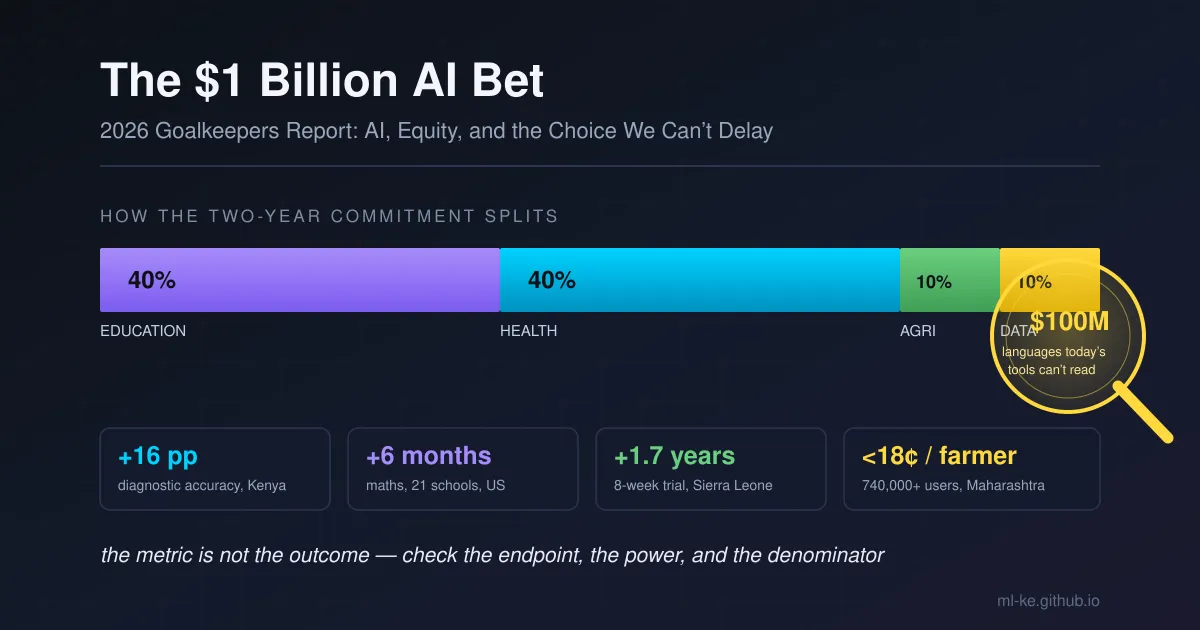
The commitment is a two-year spend of at least US$1 billion, distributed roughly as follows across the foundation’s priority areas.
| Share | Area | What the money is for |
|---|---|---|
| 40% | Education | AI tutoring to individualise student learning; teaching tools for classrooms in the US and abroad |
| 40% | Health | Diagnostics and clinical decision support for frontline health workers; maternal and newborn care tools; drug and vaccine discovery |
| 10% | Agriculture | AI-generated advice for smallholder farmers, customised to their soil, weather, and crops |
| 10% | Digital foundation | The substrate equitable AI needs, including datasets in languages current tools do not understand |
The framing rests on three “building blocks” — make AI tools work in every language people speak; build tools for the contexts in which people will actually use them, with countries and communities deciding how data is managed; and invest in people and access so communities can shape how AI works for them.
The report’s own diagnosis of the market failure is worth quoting, because it is the same argument ML engineers make about training data:
“The Gates Foundation was created in part to address a basic market failure: the people with the greatest needs often have the least power to shape where innovation and investment go. AI presents the same challenge, only at much greater speed. Left to the market alone, the most capable tools will be built first for the people and institutions most able to pay for them—not necessarily for those who could benefit most.”
The gap being priced
The report quantifies why the default path under-serves most of the planet.
| Claim | Figure | Reading |
|---|---|---|
| Training-data skew | More than 90% of the data used to train early large language models came from English-language sources | The communities with most to gain are largely absent from the knowledge base |
| Speech recognition | Errors less than 6% of the time in English; the same system “fails more than 60 percent of the time” in Yoruba | A tenfold error gap on a major West African language |
| Diffusion slope | AI “gets sharper and more capable for the one billion (mostly English-speaking) people who already have access and stays the same for the other seven billion” | The report’s endnote is explicit: these two figures are illustrative, not precise measurements |
| Health workforce | Sub-Saharan Africa: one doctor per roughly 2,000 people; high-income countries: fewer than 200 | Closing the ratio would require more than two million additional doctors |
Two things stand out. First, the workforce arithmetic is the reason clinical decision support is the flagship application rather than an abstract productivity play: the report’s argument is that you cannot train your way out of a 2,000-to-1 ratio fast enough, so you give today’s nurses and community health workers more reach. Second, the report is honest about the limits of its own numbers — it flags the one-billion/seven-billion framing as illustrative and points to World Bank and Microsoft AI Economy Institute work for the underlying access gap. That kind of footnote discipline is exactly what readers should demand from any AI deployment claim.
The four numbers the report leads with
The report’s evidence page presents four foundation-supported deployments. Each is a real deployment with a measured result — not a simulated benchmark.
| Tool | Where | Headline figure | What it measures |
|---|---|---|---|
| Penda Health clinical copilot | Nairobi, Kenya | +16 percentage points in diagnostic accuracy | Decision quality across primary care visits; AI embeds in the record and clinicians keep full autonomy |
| Kiddom Atlas | United States | +6 months of additional learning in a single school year | Grade 7 maths gains in early pilots across 21 middle schools |
| Gemini Guided Learning | Sierra Leone | +1.7 years of typical learning progress | An eight-week trial across 12 schools; the tool answers a question with a question |
| MahaVISTAAR | Maharashtra, India | <18 cents per farmer | Government operating cost per active user across 740,000+ enrolled farmers, with 70,000 new users a month |
Read as a set, they cover health, education, and agriculture — the 40/40/10 allocation — across three continents. The Kenya entry carries the most independent evidence, which makes it the right place to start pulling the numbers apart.
How to read the four numbers
1. +16 percentage points is a decision metric, not a patient outcome
The Goalkeepers figure describes diagnostic accuracy — whether the clinician’s recorded diagnosis and treatment plan matched guideline-concordant care. That is a leading indicator, and it is a real one. It is not a claim that patients got better.
That distinction matters because the same Kenyan deployment has been independently evaluated — and the results are more stratified than one number suggests.
| Study | Published | Design | Result |
|---|---|---|---|
| Nature Medicine, pragmatic cluster-randomised trial (University of Birmingham, NIHR) | 26 June 2026 | More than 9,600 patients, 16 primary care clinics in Kenya; clinicians randomised to the record system with or without AI Consult | Safe, and improved quality of clinical decision-making and notes — but no statistically significant difference in short-term patient outcomes; treatment failure within 14 days was 2.2% with AI versus 2.0% with standard care |
| Nature Health, retrospective safety evaluation | 10 March 2026 | 1,469 records reviewed across 16 clinics, July–September 2024 | Hallucinations in 3.4% of encounters; guideline-aligned management in 99%; clinicians left documentation unmodified in 62% of encounters; actively harmful recommendations in 7.8%, 67 of which reached the final documentation |
The Birmingham authors are not evasive about why: serious outcomes are rare in primary care, so detecting a modest effect could require studies “potentially involving more than 100,000 patients.” That is testable arithmetic rather than rhetoric. Here is the two-proportion power calculation behind it, run in stdlib Python:
1
2
3
4
5
6
7
8
9
10
11
12
13
14
15
16
"""Why ~9,600 patients cannot settle a 2% endpoint."""
from statistics import NormalDist

nd = NormalDist()
ALPHA, POWER, P_CONTROL = 0.05, 0.80, 0.020  # control-arm rate: 2.0%


def n_per_arm(p1, p2, alpha=ALPHA, power=POWER):
    """Normal-approximation sample size per arm for two independent proportions."""
    z_a, z_b = nd.inv_cdf(1 - alpha / 2), nd.inv_cdf(power)
    return (z_a + z_b) ** 2 * (p1 * (1 - p1) + p2 * (1 - p2)) / (p1 - p2) ** 2


for rel in (0.30, 0.20, 0.10, 0.05):
    n = 2 * n_per_arm(P_CONTROL, P_CONTROL * (1 - rel))
    print(f"detect a {rel:.0%} relative drop -> two-arm total {n:>9,.0f}")
The output, verbatim:
1
2
3
4
detect a 30% relative drop -> two-arm total    14,566
detect a 20% relative drop -> two-arm total    34,676
detect a 10% relative drop -> two-arm total   146,287
detect a 5% relative drop -> two-arm total   600,267
At a 2.0% event rate, a trial of roughly 9,600 patients reaches about 66% of the sample needed to detect even a 30% relative reduction in treatment failure — and these figures ignore the design effect of cluster randomisation, which inflates them further. The null result is therefore best read as underpowered for small effects, not as AI does not work. Both readings are defensible; only the second one gets published as a headline.
2. +6 months came from early pilots
The Kiddom figure is “early pilots across 21 middle schools,” reported as six additional months of maths learning in one school year. It is a genuine multi-school deployment, but the report cites a write-up in The 74 whose own endnote records that the author is a co-founder of Kiddom. That does not make the number wrong; it means looking for independent replication before treating the effect size as transferable — the standard we apply to any vendor-reported benchmark.
3. +1.7 years is a trial result, so check the duration
“Up to 1.7 years of typical learning progress” comes from an eight-week trial across 12 schools in Sierra Leone, and it is stated as a maximum (“up to”), not an average. Short-duration trials can produce large effects that partly reflect novelty and teacher attention — and the cited source is the DeepMind/Fab AI write-up, not a peer-reviewed paper. For an implementer, the question is not whether 1.7 years is impressive but whether the effect persists at month twelve.
4. Under 18 cents per farmer hides a denominator
MahaVISTAAR is the most concrete number in the set: more than 740,000 farmers enrolled, 70,000 joining monthly, and a government cost “less than 18 cents per farmer.” The endnote defines the denominator precisely — government operational cost per active user as of late 2025. That is a cost-to-serve number, so it excludes the upstream build (data pipelines, model hosting, evaluation, and the agronomy that keeps answers correct). It is still a remarkable unit economics result for a service delivered by app, voice call, and chat in a farmer’s own language; it is not a total cost of ownership.
One disclosure applies to all four: the report’s endnotes record that the Gates Foundation has provided support to Penda Health, Kiddom, MahaVistaar, and to Fab AI, the implementing partner in Sierra Leone. A funder documenting its own portfolio is normal, and stating it plainly is the right behaviour — but readers should treat the set as existence proofs of what is possible, which is how the report describes it: “early evidence… They are not the only tools showing promise in these sectors.”
A checklist for any AI deployment claim
The four numbers transfer into a reusable discipline. Before citing an AI program’s result, ask:
| Question | Why it bites |
|---|---|
| Is this a decision metric or an outcome metric? | Note quality and diagnostic accuracy are upstream of patient benefit, and the causal chain can break in between |
| Was the evaluation powered for this endpoint? | A null result at 9,600 patients against a 2% event rate cannot distinguish “no effect” from “small effect” |
| Who wrote the source being cited? | Vendor-authored write-ups are useful but need independent replication before effect sizes travel |
| What is the denominator, and what is excluded? | “Per active user” ≠ per registered user ≠ total cost of ownership |
| Was the rate a maximum or an average? | “Up to 1.7 years” and “740,000 farmers” carry different confidence than a mean with an interval |
What this means if you build in Kenya
The allocation itself is a signal about which engineering problems now have funding attached:
- Multilingual data and evaluation. 10% of the commitment — roughly $100 million — is earmarked for the “digital foundation,” explicitly including datasets in languages today’s tools do not understand. The binding constraint is not model weights; it is language coverage and evaluation sets built on how people actually speak, which is where local teams have an unfair advantage.
- Context grounding. The report’s second building block is about local epidemiology, available treatments, and clinic operating conditions. In practice that is retrieval, adaptation, and guardrail work on top of a base model, plus writing down what “correct” means in a specific facility.
- Human capacity. The third block funds people who can evaluate tools, not just buy them. Skills in measurement design, data quality, and deployment monitoring are the ones the report explicitly says are missing.
- Prospective measurement. The sharpest lesson from the Kenya evidence is that the field has moved past demo-ware. Asking “what is my endpoint, and is this study powered to detect it?” is now the difference between a pilot that scales and a pilot that stalls.
Key takeaways
| Takeaway | Detail |
|---|---|
| The commitment | At least US$1 billion over two years, announced September 14, 2026 with the tenth Goalkeepers Report |
| The allocation | 40% education, 40% health, 10% agriculture, 10% digital foundation including low-resource-language datasets |
| The strongest claim | Kenya’s clinical copilot: +16 percentage points in diagnostic accuracy, embedded in real primary care visits |
| The honest caveat | The same Kenyan deployment showed no significant change in 14-day patient outcomes in a randomised trial of more than 9,600 patients |
| The arithmetic | At a 2.0% event rate, detecting a 10% relative reduction needs roughly 146,000 patients before clustering inflates it |
| The unit-economics win | India’s MahaVISTAAR serves 740,000+ farmers at under 18 cents per active user in government operating cost |
| The deadline the report sets | Decisions about how AI is built, funded, and deployed in the next 12 to 18 months determine who benefits |
References
- Gates Foundation, Gates Foundation Commits US$1 Billion to Help Build and Deliver Equitable AI That Improves Health and Expands Opportunity (September 14, 2026) — gatesfoundation.org
- Goalkeepers, 2026 Goalkeepers Report: Make This Matter — AI, Equity, and the Choice We Can’t Delay — full PDF
- Benton Institute for Broadband & Society, Gates Foundation: AI Could Help the Poorest Catch Up, or Leave Them Further Behind — benton.org
- Ghana Business News / GNA, Gates Foundation commits $1b to help deliver equitable AI (September 22, 2026) — ghanabusinessnews.com
- CIO Africa, Gates Foundation Commits $1B Towards Equitable AI (September 15, 2026) — cioafrica.co
- University of Birmingham, AI clinical support tool improved clinician decisions in real-world primary care trial (June 26, 2026) — birmingham.ac.uk
- Nature Medicine, generative AI-enabled clinical decision support in primary care: a pragmatic cluster-randomised trial — nature.com
- Nature Health, safety of a large language model-based clinical decision support system in African primary healthcare (March 10, 2026) — nature.com
- Innovation Village, AI Africa Intelligence, September 10–16, 2026 — innovation-village.com