Three New Series: Building AI Agents, African AI, and AI Infrastructure
We’ve spent the last two weeks diving deep into AI security — from MLSecOps: Securing the ML Pipeline to ML Pipeline Secrets Management — and the response has been incredible. The MLsecOps series showed us how fragile our pipelines really are, and that knowledge matters.
But security isn’t the only story. It’s time to build.
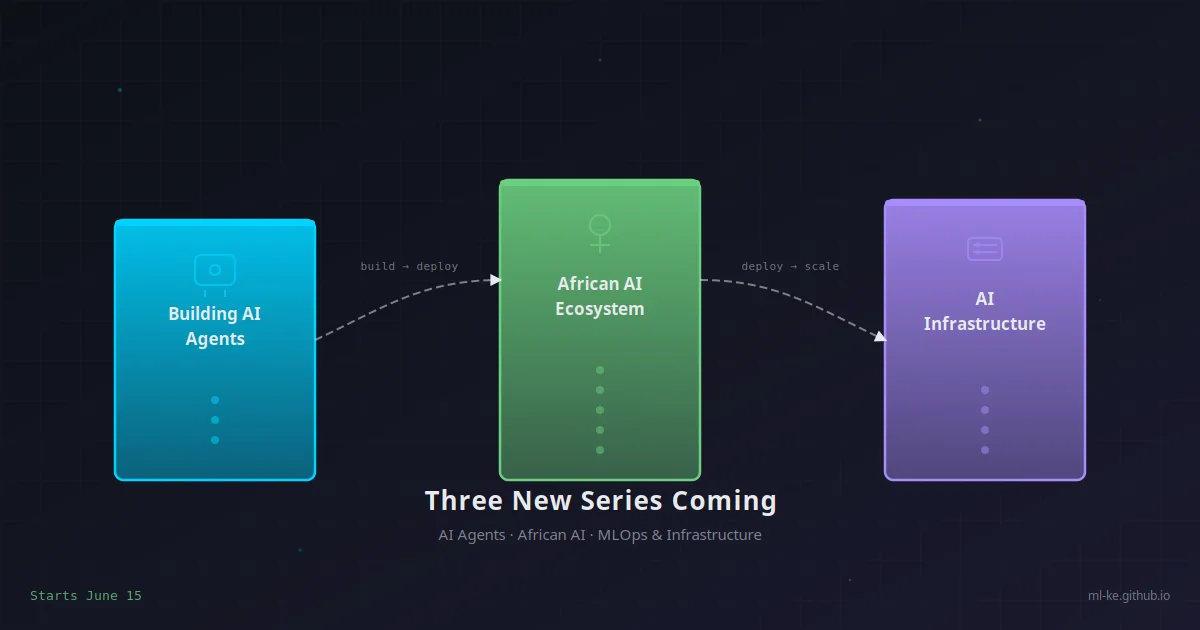
Starting June 15, ml.co.ke launches three concurrent series that span the full AI stack — from writing your first agent loop to deploying at scale in African cloud environments. These series will run in parallel, cross-referencing each other as they unfold.
Here’s what’s coming.
Series 1: Building AI Agents from Scratch 🧠
| **Starts: June 15 | Frequency: Weekly (Mon/Wed/Fri)** |
Agents are this year’s defining paradigm shift. Every major AI lab is betting on agentic systems — and for good reason. LLMs alone can’t act. Agents can.
This series covers:
- Agent fundamentals — ReAct loops, tool calling, memory systems
- Multi-agent architectures — Orchestration, delegation, supervisor patterns
- Observability & debugging — Tracing agent decisions, handling failure modes
- Agent security — Prompt injection in agent loops, tool access control
- Production deployment — State management, rate limiting, fallback chains
Whether you’re building a simple chatbot with function calling or a multi-agent research system, this series gives you the architecture and code.
Prerequisites: Python, basic LLM API experience. We’ll build everything from first principles.
Series 2: AI in the African Ecosystem 🌍
| **Starts: June 17 | Frequency: Bi-weekly (Tue/Thu)** |
AI doesn’t exist in a vacuum. The tools, datasets, and infrastructure that work in San Francisco or London don’t always translate. Africa has unique realities — mobile-first users, intermittent connectivity, low-resource languages, local regulatory frameworks — that demand different approaches.
This series covers:
- Swahili & low-resource NLP — Tokenization, dataset building, fine-tuning for African languages
- Mobile-first AI — On-device inference, model compression, offline-capable agents
- African AI communities — The labs, startups, and research groups shaping the continent
- AI for agriculture & healthcare — Real-world deployment case studies from East Africa
- Local data sovereignty — Regulatory landscapes, data localization, compliant infrastructure
The goal isn’t just commentary — it’s actionable guidance for building AI that works in African contexts.
Series 3: AI Infrastructure & MLOps ⚙️
| **Starts: June 19 | Frequency: Weekly (Tue/Thu/Sat)** |
Agents need infrastructure. Models need deployment pipelines. Data needs versioning. This series tackles the engineering backbone:
- Model serving 101 — vLLM, TGI, Triton Inference Server, ONNX Runtime
- GPU optimization — CUDA graphs, tensor parallelism, quantization, PagedAttention
- Kubernetes for ML — Kubeflow, K8s operators for model serving, autoscaling
- CI/CD for ML pipelines — DVC, MLflow, automated retraining, A/B testing in production
- Monitoring & observability — Drift detection, alerting, LLM eval pipelines
- Secrets & security — Building on our earlier ML Pipeline Secrets Management post into production-grade vault patterns
This series pairs tightly with the Agents series — you’ll see the infrastructure patterns behind the agent architectures.
How the Three Series Connect
Think of them as a stack:
| Layer | Series | Focus |
|---|---|---|
| Applications | Building AI Agents | What you build — agent logic, tool use, multi-agent systems |
| Context | AI in the African Ecosystem | Where and for whom you build — local languages, mobile, regulation |
| Foundation | AI Infrastructure & MLOps | How you run it — serving, scaling, monitoring, security |
You don’t need all three to benefit — jump in at any layer. But if you follow all three, you’ll see the same patterns appear at every level. An agent’s tool-use loop (Series 1) mirrors the request routing patterns you’ll learn in infrastructure (Series 3). The mobile-first constraints from Series 2 inform the quantization strategies in Series 3.
New content will drop every weekday, alternating between series so you always have fresh material.
The Roadmap
| Date | Series | Topic |
|---|---|---|
| June 15 (Mon) | Agents | Setting Up Your AI Dev Environment |
| June 16 (Tue) | Infrastructure | Model Serving 101: From Notebook to API |
| June 17 (Wed) | Agents | The ReAct Loop: Building Your First Tool-Calling Agent |
| June 18 (Thu) | Africa | Swahili NLP: Tokenization for Low-Resource Languages |
| June 19 (Fri) | Infrastructure | GPU Optimization for Inference |
| June 22 (Mon) | Agents | Memory Systems: Short-Term, Long-Term, and Episodic Memory |
| June 23 (Tue) | Africa | Mobile-First AI: On-Device Inference with TFLite & ONNX |
| June 24 (Wed) | Infrastructure | Kubernetes for ML: Deploying with Kubeflow |
| June 25 (Thu) | Agents | Multi-Agent Architectures: Orchestration Patterns |
| June 26 (Fri) | Africa | AI for Agriculture: Crop Disease Detection in East Africa |
| June 29 (Mon) | Agents | Agent Observability: Tracing, Logging, Debugging |
| June 30 (Tue) | Infrastructure | CI/CD for ML: Automating the Pipeline |
| July 1 (Wed) | Africa | Data Sovereignty: Building Compliant AI Infrastructure |
| July 2 (Thu) | Agents | Agent Security: Defending Against Prompt Injection at Runtime |
| July 3 (Fri) | Infrastructure | Monitoring & Drift Detection in Production LLM Systems |
We’ll update this roadmap as we go, and reader feedback shapes the course. If there’s a topic you want covered, comment or reach out.
What About MLsecOps?
The MLsecOps series isn’t ending — it’s evolving. Security remains a thread woven through all three new series. You’ll see:
- Agent-specific security patterns in the Agents series
- Data sovereignty and compliance in the African AI series
- Secrets management, pipeline hardening, and runtime security in Infrastructure
Our earlier posts — from Prompt Injection: The #1 LLM Security Risk to Real-Time Multimodal Security — still serve as the foundation. We’ll reference them, build on them, and continue publishing dedicated security deep-dives alongside the new series.
Next Up
Setting Up Your AI Dev Environment — The Agents series kicks off June 15 with a complete walkthrough: Python environment setup, LLM provider configuration, tool-calling scaffolding, and a minimal end-to-end agent you can run in under 30 minutes.
See you Monday. 🚀