Bridging Hermes and OpenCode Skill Libraries: One Sync Script, 18 Skills
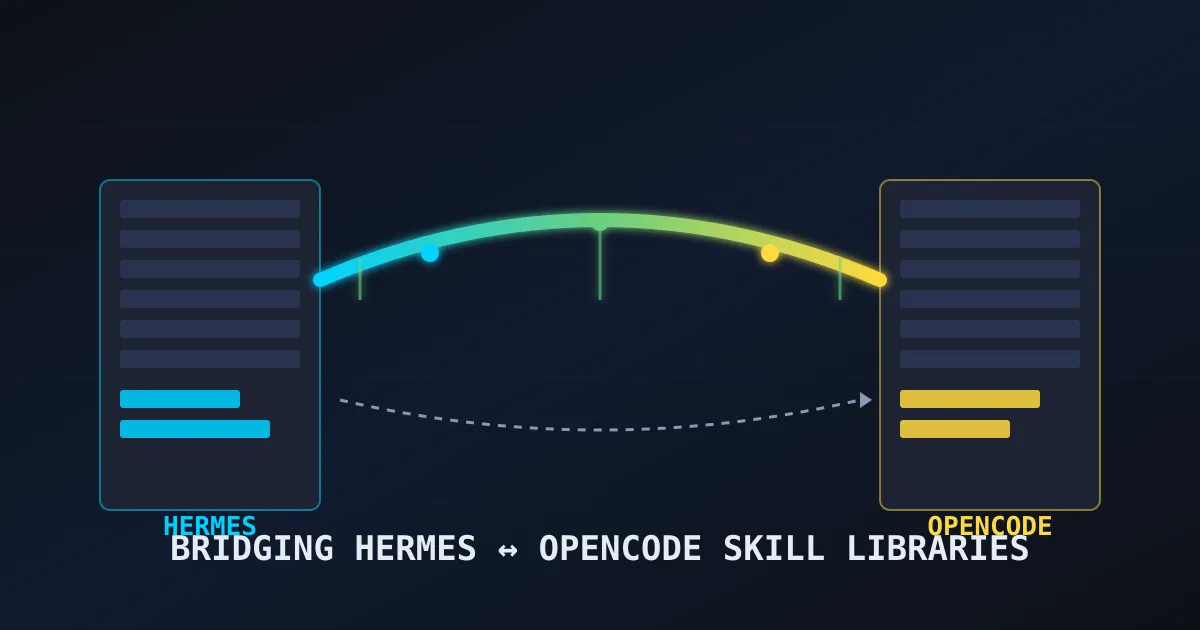
The Problem: Two Agents, Two Skill Libraries, One Source of Truth
We run a two-agent workflow: Hermes for planning, orchestration, and verification; OpenCode for heavy implementation. Each agent has its own skill system with its own directory layout — and for months, they drifted.
When we improved a methodology skill in Hermes — say, our bug-bounty reconnaissance playbook — OpenCode kept running the old version. The fix existed in one library but not the other. Nobody noticed until a subagent followed a stale procedure and we had to backtrack.
That’s the problem this post solves: a skill bridge — one script that syncs curated methodology skills from Hermes into OpenCode, so both agents always see the latest playbooks.
Why Not Just Symlink?
The naive approach is a symlink: point OpenCode’s skill directory at Hermes’s. It fails for three reasons:
- Format differences. OpenCode’s skill schema isn’t identical to Hermes’s. Frontmatter fields differ, and some Hermes skills use references/scripts that need path translation.
- Curated subset, not everything. We don’t want all 128 Hermes skills in OpenCode — many are Hermes-specific (cron management, gateway config). OpenCode gets the methodology skills: recon, exploitation, report writing, skill authoring.
- Validation per ecosystem. Each library has its own validator and scanner. A bridge that writes raw files bypasses both; a bridge that syncs and then validates preserves the guardrails.
The Bridge Script
The script (opencode_skills_bridge.py) does three things:
- Reads the curated manifest — an explicit list of Hermes skills that have OpenCode equivalents or are methodology-generic (recon, pentest playbooks, report templates)
- Transforms frontmatter — maps Hermes metadata to OpenCode’s schema (tags, category, related_skills get translated; Hermes-only fields get dropped)
- Writes to
~/.config/opencode/skills/atlas-*and runs both validators afterward
The atlas- prefix is deliberate: it namespaces bridged skills so we can distinguish curated methodology from OpenCode’s own installed skills, and so a future sync can safely delete-and-replace without touching anything else.
First Sync Results
The inaugural run bridged 18 atlas-* skills into OpenCode:
- Recon & exploitation: recon-to-exploitation, api-hacking-methodology, idor-testing-methodology, ssrf-testing, jwt-attacks, saml-attacks
- Reporting: pre-submission-verification, hackerone-submission-template, bugcrowd-submission-template, anti-AI-report-writing
- Meta: skill-quality-audit, attack-chain-synthesis, chaining-methodology, business-logic-flaws, mass-assignment-method-tampering
Post-sync validation: 0 errors on both sides. The bridge also runs the security scanner over the OpenCode library after syncing, so a bridged skill can’t quietly smuggle in a scanner flag.
Operational Lessons
1. The bridge must be idempotent. Re-running it should produce the same result with no drift. Ours deletes its own atlas-* namespace before re-syncing — safe because nothing outside that namespace is touched.
2. Sync must trigger on change, not on schedule. We wired the bridge into our weekly learning sweep cron, but the real rule is: run after ANY Hermes skill change. The weekly cadence catches most drift; the manual invocation catches the rest. (In practice: the cron re-syncs every Tuesday, and we run it manually whenever we patch a methodology skill mid-week.)
3. Validation is the bridge’s seatbelt. A sync that doesn’t re-validate is just copy-paste with extra steps. The bridge runs skill_validator.py on both libraries immediately after writing, so a broken transform fails loudly at sync time instead of silently degrading OpenCode’s behavior.
4. Curate the manifest ruthlessly. Every skill in the bridge is there because OpenCode’s coding-agent workflow needs it. Skills that are Hermes-infrastructure-specific (cron, gateway, platform adapters) stay out. A smaller, sharper library is easier to validate, scan, and trust.
The Bigger Pattern
This isn’t really about Hermes and OpenCode — it’s about any multi-agent setup where agents share institutional knowledge. The pattern generalizes:
- One source of truth (the curator’s library) and one-way sync (curated → consumers)
- Namespaced output so consumers can be reset safely
- Post-sync validation so the transform can’t corrupt the target
- Explicit manifest so the curated subset is a decision, not an accident
If you’re running multiple agents and your skills are drifting, you don’t need a fancier agent — you need a bridge, a manifest, and a validator. All three fit in one script, and the first sync pays for the whole thing in avoided stale-procedure incidents.
Follow-up to: How We Built a Skills-Powered Coding Agent with OpenCode and Validating 300+ Agent Skills