DeepSeek V4 Peak/Off-Peak Pricing: The End of Flat-Rate LLM APIs
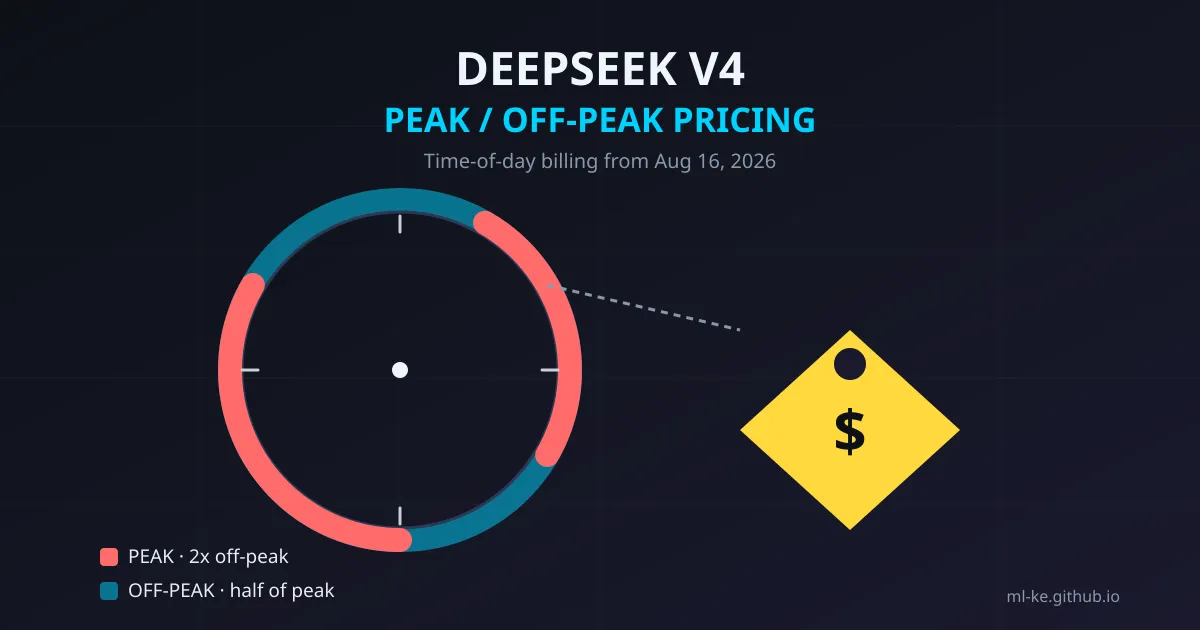
DeepSeek introduces time-of-day billing
On August 16, 2026 at 16:00 UTC (19:00 EAT), DeepSeek switches its V4 API from flat-rate pricing to peak / off-peak billing — a first for a major Chinese model provider at this scale. Off-peak rates are exactly half of peak rates, and the peak windows are narrow: 01:00–04:00 and 06:00–10:00 UTC, which translates to 04:00–07:00 and 09:00–13:00 EAT. Everything else — roughly 75% of the day for Kenyan users — is off-peak.
The headline: even the new off-peak rates are more expensive than today’s prices, and peak rates are 2–4× current levels depending on token type. The era of flat, ever-declining API prices is over for DeepSeek.
What actually changes
| Model | Period | Input (cache hit) | Input (cache miss) | Output |
|---|---|---|---|---|
| v4-flash | Today | $0.0028 | $0.14 | $0.28 |
| Off-peak | $0.007 (↑150%) | $0.22 (↑57%) | $0.66 (↑136%) | |
| Peak | $0.014 (↑400%) | $0.44 (↑214%) | $1.32 (↑371%) | |
| v4-pro | Today | $0.003625 | $0.435 | $0.87 |
| Off-peak | $0.022 (↑507%) | $0.66 (↑52%) | $1.98 (↑128%) | |
| Peak | $0.044 (↑1114%) | $1.32 (↑203%) | $3.96 (↑355%) |
All prices per 1M tokens. Source: DeepSeek pricing docs.
Two patterns stand out. First, cache-hit input is the biggest jump — 150–507% off-peak, up to 1,114% at peak for v4-pro. DeepSeek is pricing the convenience of hot KV-cache reads much closer to their real serving cost. Second, output tokens are the real money: at peak, a v4-pro output token costs $3.96/1M, over 4.5× today’s price. Anyone running agent loops or long generation pipelines just saw their bill’s dominant line item inflate.
Why now: inference is a capacity business
This is textbook demand-shaping, straight out of the electricity market playbook. When a model is as popular as V4 — released April 24, 2026 with 87.5 MMLU-Pro, 80.6% SWE-bench Verified and 93.5 LiveCodeBench for v4-pro (official numbers) — the marginal cost of serving a token at 3 a.m. is far lower than at 9 a.m. Peak/off-peak pricing nudges batch jobs and cron workloads into the cheap hours, smoothing the load curve without building idle capacity.
DeepSeek’s own efficiency claims make the economics visible: the V4 technical report says v4-pro needs only 27% of the single-token inference FLOPs and 10% of the KV cache of V3.2 in the 1M-token setting. That efficiency is why V4 could undercut Western labs for months — but capacity is still finite, and time-of-day pricing is the lever that keeps utilization high without rationing.
DeepSeek is not alone — the whole market is repricing
The flat-rate-to-dynamic shift is happening while frontier labs are raising prices across the board:
- Anthropic: Claude Sonnet 5 launched at intro pricing of $2/$10 per 1M input/output tokens — and that intro pricing ends August 31, 2026, with an increase effective September 1.
- OpenAI: GPT-5.5 launched at roughly 2× GPT-5.4’s per-token price (GPT-5.4 was $2.50/$15), with the flagship tier now at $30/1M input. A 10% regional-processing uplift applies to models released on or after March 5, 2026.
- Google is the counter-trend: Gemini 3.7 and 3.6 Flash are offered at $0.75/$3.75 introductory pricing through December 31, 2026 — a deliberate price cut against the hiking pack.
The market is bifurcating: frontier labs raise prices while challengers (and open weights) compress them. DeepSeek’s move is best read not as a pure hike but as capacity management — they keep the absolute floor low (cache-hit at $0.007 off-peak is still cheaper than any Western frontier model) while making the premium tiers behave like a real utility.
What this means for how we use LLMs
1. Time-shift everything that can wait. Batch inference, nightly indexing, evals, report generation, training-data synthesis — anything without a hard latency requirement should run in off-peak hours. For Kenya, that means scheduling heavy workloads after 13:00 EAT (and avoiding the 09:00–13:00 morning peak entirely).
2. Cache hits are now the single biggest lever. A cache-hit input token at off-peak is ~30× cheaper than a cache-miss ($0.007 vs $0.22 for v4-flash). Designing prompts with stable system prefixes, shared context blocks, and conversation-level caching isn’t an optimization anymore — it’s the difference between a $10/month bill and a $300/month bill on high-volume workloads.
3. Judge models by price-per-benchmark-point, not sticker price. The old DeepSeek story was “near-frontier quality at 1/10th the price.” The new story is “near-frontier quality at 1/10th the price if you schedule smart.” At off-peak, v4-flash output at $0.66/1M with 79.0% SWE-bench Verified is still a phenomenal deal vs GPT-5.5 Pro at $30/1M input. At peak, the gap narrows fast.
4. Agents change the calculus. Agent loops are output-heavy and latency-sensitive — the two things peak pricing punishes hardest. Expect agent platform costs to be the first thing renegotiated, and expect providers to start offering agent-specific off-peak tiers.
Practical takeaway for Kenyan teams
With EAT peak hours at 04:00–07:00 and 09:00–13:00, the cheapest compute day looks like: schedule cron jobs and batch pipelines after 13:00, keep interactive work on cache-heavy prompts, and push any 24/7 agent workloads to the 13:00–04:00 window where possible. This is the same demand-response thinking that keeps Kenyan electricity tariffs lower at night — applied to tokens.
Bottom line: DeepSeek’s peak/off-peak model is the first visible sign that LLM pricing is maturing from “race to the bottom” to “capacity market.” The cheap era isn’t over — it’s just moved to specific hours, and the teams that schedule around it will pay a fraction of what the peak-hour crowd pays.
References
- DeepSeek API pricing docs — official peak/off-peak announcement
- Macaron: DeepSeek V4 Benchmarks — official V4 benchmark summary
- Claude pricing docs — Sonnet 5 intro pricing ending Aug 31
- OpenAI API pricing — GPT-5.5 tiers and regional uplift
- Google Cloud Agent Platform pricing — Gemini 3.7/3.6 Flash intro pricing