Twelve Hours and 1,239 Certificates: What Kenya's Civil-Service AI Course Delivered
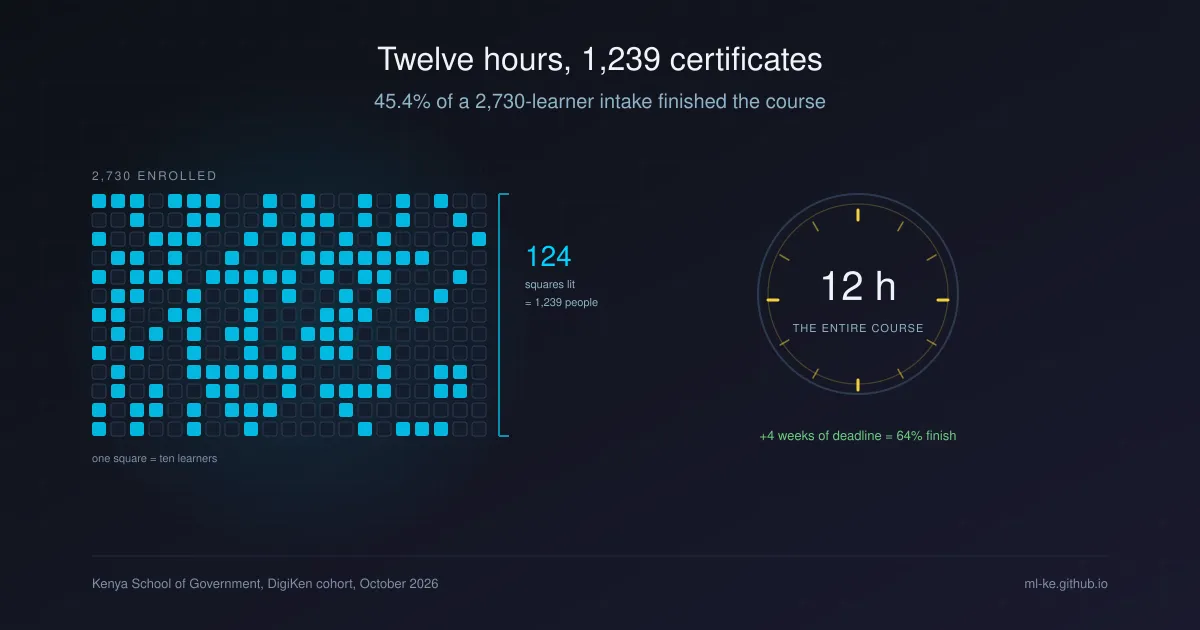
The short version The Kenya School of Government has turned its e-learning arm into an institute for digital and emerging-technology training, the e-Learning and Information Technology Institute. The launch doubled as a graduation: 2,730 learners registered for the UNESCO-Oxford course on AI and digital transformation in government, and 1,239 finished it. That is a 45.4% finish rate, and it is the most useful number in the announcement.
The Kenya School of Government is the training arm of the country’s public service, and in early October it gave that arm a new name and a wider mandate. The e-Learning and Information Technology Institute, which the school calls eLITI, was reported by Citizen Digital on 9 October and by TechAfrica News four days later. It inherits a line that runs back to the Kenya Development Learning Centre in 2003, later renamed the eLearning and Development Institute.
The same event graduated the first DigiKen cohort. DigiKen is the Digital Platforms Kenya programme, funded by the UN Joint SDG Fund and delivered through the school, and the course itself was written by UNESCO and the University of Oxford’s Saïd Business School. UNESCO’s account of the Kenyan launch describes it as the country’s route into a course built for civil servants worldwide.
Two thousand seven hundred and thirty people registered. One thousand two hundred and thirty-nine finished. The difference is 1,491 people, and that gap is where the engineering hides, because a training programme is a deadline with a queue in front of it, and how the queue behaves is a design decision rather than a verdict on the learners.
What was stood up
The institute’s remit, as TechAfrica News describes it, covers digital learning and ICT skills, emerging technologies, research, and advisory services, plus partnerships. That is broader than a training centre: a school that only runs courses cannot tell a ministry which skills it is missing.
At the launch the school showed virtual reality simulations, AI applications, and AI agents built by the institute for deployment through Konza Technopolis, Kenya’s technology and innovation hub. Treat that as a pipeline rather than a shipped system: neither write-up names a product, a date or a licence.
There is also a grassroots plan. The school’s “Under the Tree Series” is meant to take practical digital skills training out of Nairobi and into communities, in the same way that a mobile clinic takes a service to a place that has no building for it.
The director general, Professor Nura Mohamed, framed the timing around service delivery: digital platforms, data and AI increasingly shape how government works, and the institute consolidates the school’s e-learning, IT and digital transformation work so it can train, research, and advise in one place (Citizen Digital). The institute has also said it will work with public institutions to identify emerging skills gaps and design programmes against them.
Five organisations sit behind the cohort, and their roles are worth separating.
| Actor | Role | What it contributed |
|---|---|---|
| Kenya School of Government | Host and delivery | Ran the cohort, launched eLITI, owns the new institute |
| UNESCO | Co-author | Wrote the course with Oxford; supplied the competency framework it is built on |
| University of Oxford, Saïd Business School | Co-author | Co-wrote the course; the certificate is issued jointly |
| UN Joint SDG Fund | Funder | Finances DigiKen, the programme the course was delivered under |
| Konza Technopolis | Destination | Named as where agents built by the institute are meant to be deployed |
Twelve hours is the entire course
The course is called AI and Digital Transformation in Government, and it takes twelve hours. It is free, it is open access, and it ends in a certificate issued jointly with Saïd Business School (UNESCO). It launched in English and Spanish in November 2025, with French, Portuguese and Arabic to follow. It sits inside the SPARK-AI Alliance, a network UNESCO set up with more than 50 public administration training organisations.
The syllabus is organised around three areas, named in the framework the course is built on:
- Digital planning and design, which is about finding the real problem and choosing where innovation is worth the effort.
- Data use and governance, which covers managing data responsibly and safeguarding rights, privacy and security.
- Digital management and execution, which is leading teams, running projects, and bringing the public into the design of a service.
None of those three is a machine-learning course: no model training, no evaluation harness, no retrieval pipeline. What the certificate attests is that an officer can read a digital project, ask the questions that decide whether it should exist, and name the data-protection obligations attached to it.
That is a defensible scope for a first cohort of 2,730. UNESCO’s write-up cites the World Bank for the claim that the public sector employs a third of the global workforce, and UN DESA data from 2024 for two harder numbers: fewer than half of the world’s countries have integrated AI into national e-government strategies, and only 21% address its ethical use in public administration.
Read those two figures together and the design choice makes sense. If most governments have no AI line in their digital strategy, then the binding constraint is not engineering talent at the centre; it is the number of people in ministries who can tell a good proposal from a bad one. Twelve hours is enough to move an officer from spectator to participant in that decision. It is not enough to make them the person who builds the thing, and a programme that claims otherwise is selling something else.
Reading the 45% honestly
Citizen Digital reports 2,730 “public officers and other learners from both the public and private sectors”, of whom 1,239 completed. So 45.4% is the finish rate of the whole intake, not of the public service, and the 1,239 are described as public officers who completed the UNESCO-Oxford programme. Both facts belong in the same sentence as the percentage; it means something different depending on which one you leave out.
Now the volume. Twelve hours times 1,239 completions is 14,868 officer-hours, or about 1,858 eight-hour working days. Spread across a public service, that is a thin layer. Concentrated in the ministries that sent people, it is a real one: enough trained colleagues in a room that a vendor’s slide claiming 94% accuracy gets a question about which dataset the number came from and whether the model was tested on Kenyan records.
That is the return on a course like this, and it will never appear in a completion dashboard. The measurable output is certificates. The outcome is a procurement conversation that takes ten minutes longer than it used to.
The other side of the ledger is the 1,491 who registered and did not finish, and here the public record is silent. Were they transferred, reassigned, promoted, or simply unable to find 12 hours across the term? Those are different problems with different fixes, and only the programme can tell them apart. What is clear without inside information is that this group is the cheapest capability in the building: they have already chosen the subject, they have a platform account, and a second attempt designed around their schedule costs almost nothing.
What a deadline costs, in officers
Here is the arithmetic that decides whether a cohort finishes, and it does not involve the content at all.
Twelve hours of coursework spread over an eight-week term means 1.5 hours every week for eight consecutive weeks. Not 12 hours in total, which almost anyone can find; 1.5 hours in each of eight specific weeks, which is a scheduling commitment. A civil servant with a reporting deadline, a transfer or a week of fieldwork misses one, and the model below assumes the missed hours are never made up.
The simulation gives each learner a weekly study capacity drawn from a lognormal distribution, calibrated so the eight-week version reproduces the reported 45.4% finish rate, then reruns the same population under four design changes.
1
2
3
4
5
6
7
8
9
10
11
12
13
14
15
16
17
18
19
20
21
22
23
24
25
26
27
28
29
30
31
32
33
34
35
36
37
38
39
40
41
42
43
44
45
46
47
48
49
50
51
52
53
54
55
56
import math, random

HOURS = 12.0      # course length, UNESCO (10 Oct 2025)
ENROLLED = 2730   # DigiKen intake reported by Citizen Digital
FINISHED = 1239

def cohort(n=200000, median_h=1.35, sigma=0.85, weeks=8, bonus=0.0,
           hours=HOURS, seed=11):
    """Share of learners who clear `hours` of content within `weeks`."""
    rng = random.Random(seed)
    done = 0
    for _ in range(n):
        weekly = math.exp(rng.gauss(math.log(median_h), sigma)) + bonus
        left = hours
        for _ in range(weeks):
            left = max(0.0, left - weekly)
            if left == 0.0:
                break
        if left == 0.0:
            done += 1
    return done / n

def solve(weeks, target=FINISHED / ENROLLED, lo=0.05, hi=4.0):
    """Median weekly hours that reproduces the reported finish rate."""
    for _ in range(24):
        mid = (lo + hi) / 2
        if cohort(median_h=mid, weeks=weeks) < target:
            lo = mid
        else:
            hi = mid
    return (lo + hi) / 2

print("observed: %d finished of %d enrolled = %.1f%%"
      % (FINISHED, ENROLLED, 100 * FINISHED / ENROLLED))
med = solve(8)
print("median weekly study hours needed to reproduce it in 8 weeks: %.2f h" % med)
print("mean weekly hours at that median: %.2f h" % (med * math.exp(0.85 ** 2 / 2)))
print()

base = cohort(median_h=med)
designs = [
    ("baseline: 8 weeks, 12 h", base),
    ("deadline 8 -> 12 weeks", cohort(median_h=med, weeks=12)),
    ("half a protected hour a week", cohort(median_h=med, bonus=0.5)),
    ("content 12 -> 9 hours", cohort(median_h=med, hours=9.0)),
    ("12 weeks + 0.5 h + 9 h", cohort(median_h=med, weeks=12, bonus=0.5, hours=9.0)),
]

print("%-32s %8s %11s %10s" % ("design", "finish", "per 1,000", "of 2,730"))
for name, v in designs:
    print("%-32s %7.1f%% %+11.0f %10.0f" % (name, 100 * v, 1000 * (v - base), v * ENROLLED))

print()
print("hours delivered by the 1,239 who finished: %.0f, or %.0f eight-hour days"
      % (FINISHED * HOURS, FINISHED * HOURS / 8))
print("weekly hours a learner must sustain for 8 straight weeks: %.2f" % (HOURS / 8))
1
2
3
4
5
6
7
8
9
10
11
12
13
observed: 1239 finished of 2730 enrolled = 45.4%
median weekly study hours needed to reproduce it in 8 weeks: 1.35 h
mean weekly hours at that median: 1.94 h

design                             finish   per 1,000   of 2,730
baseline: 8 weeks, 12 h             45.4%          +0       1239
deadline 8 -> 12 weeks              64.0%        +186       1747
half a protected hour a week        64.0%        +186       1747
content 12 -> 9 hours               58.8%        +134       1604
12 weeks + 0.5 h + 9 h              97.6%        +523       2666

hours delivered by the 1,239 who finished: 14868, or 1858 eight-hour days
weekly hours a learner must sustain for 8 straight weeks: 1.50
Start with the calibration lines, because they reframe the 45%. The median learner had 1.35 hours a week to give, and the mean was 1.94. Those are not numbers produced by indifference. They are the study capacity of people with full-time jobs, and the average is enough to clear 12 hours in eight weeks: 1.94 times 8 is 15.5. The average learner had enough time. The median learner, and everyone below the median, did not.
The first row of the table is the calibration, so it proves nothing except that the arithmetic can reproduce the published rate. The rest is the part worth arguing with.
Four extra weeks on the deadline move the finish rate from 45.4% to 64.0%, which on a 2,730 intake is 1,747 finishers instead of 1,239. Half an hour a week of protected study time, whether that is a calendar block, a quieter Friday, or a supervisor who treats the course as work rather than a personal project, produces the same 64.0%. Both levers are free in the sense that matters: neither requires new content, new partners, or a new platform.
Trimming the course from 12 hours to 9 buys 58.8%, or 1,604 finishers. That is a smaller gain than the deadline, and it costs something the other two do not, because the three competency areas are the reason the certificate carries a university’s name.
The last row combines all three and lands at 97.6%. Treat that as an upper bound on the scheduling channel rather than a forecast. The model has no attrition term, so it cannot represent the officer who is transferred to another county in week five, takes leave, or is reassigned to a ministerial task force. Real programmes lose those people whatever the design. The honest reading of that row is that completion in the high nineties is arithmetically available if the schedule is designed for it, and that everything below 97.6% in a real cohort is a different failure with a different fix.
The harder job the institute just took on
Skills-gap mapping sounds like a consultancy line item. In this context it is the most consequential sentence in either write-up, because it inverts the order most governments follow. The usual sequence is to buy a tool, discover that nobody can specify, test or supervise it, and then send people on a course. Mapping gaps first means the training budget sets the buying agenda instead of trailing it.
The agents destined for Konza Technopolis are where that gets tested. An agent that answers questions about a government service is a small model wrapped in a large set of decisions, and five of them decide whether it can face a citizen:
- Scope. Which services it may answer for, and what it does when the question falls outside them.
- Grounding. Which document or database the answer must be traced to, and what happens when that source is out of date.
- Escalation. The route to a human, and the point at which the agent stops trying.
- Logging. What is kept, for how long, and who reads it.
- Language. Whether it handles Kiswahili and code-switching, and what it does with a question it cannot parse.
None of that is exotic. All of it is the kind of thing a trained officer catches in a demonstration and an untrained one does not, which is the strongest argument for the twelve-hour course that this post can make. A civil service with 1,239 people who can ask those five questions is a better buyer of AI than one that has none, whatever the model benchmarks say.
The cohort also gives the institute something most new AI units lack: a test panel. Twelve hundred people who know the vocabulary, work inside the processes the agent is meant to serve, and can be asked to break it in a supervised way. Running the first Konza agent past that group before it meets a citizen costs almost nothing.
How to run a cohort that finishes
The levers above are not specific to Kenya, and none of them needs a budget line. They need decisions made before registration opens.
| Decision | Weak default | What the Kenyan numbers suggest |
|---|---|---|
| Term length | One fixed deadline set by the vendor’s licence window | Publish the deadline and then add four weeks; it is the cheapest completion gain available |
| Weekly load | Assume learners find 12 hours somewhere | 1.5 hours in each of eight weeks is a different ask from 12 hours in total; schedule it |
| Protected time | Study is personal time | Half an hour a week of recognised work time matches a four-week extension |
| Reporting | Enrolments, because they are larger | Report the finish rate and the denominator alongside the count of certificates |
| Second attempt | A new intake, from scratch | Re-recruit the people who started and stopped; they have already chosen the subject |
The reporting line is the one to take seriously. Publishing 2,730 next to 1,239 is the reason everything in this post is checkable. A programme that reports only the 1,239 gets a better headline and no ability to improve. A programme that reports both gets a to-do list, which is what an institute with a research mandate is for.
Four numbers are worth logging from the first week of any cohort like this: registrations, active learners at the end of week two, completions, and the median days from registration to first submitted assessment. The first two predict the last one better than any content-quality metric, and all four are cheap to instrument.
Key takeaways
| Point | Detail |
|---|---|
| What launched | The e-Learning and Information Technology Institute at the Kenya School of Government, reported 9 October 2026, replacing a line that began with the Kenya Development Learning Centre in 2003 |
| The cohort | 2,730 public officers and other learners registered for the first DigiKen cohort; 1,239 completed the UNESCO-Oxford course, a 45.4% finish rate |
| The course | Twelve hours, free, three competency areas (planning and design, data use and governance, management and execution), joint certificate with Oxford’s Saïd Business School |
| The gap it answers | Fewer than half of countries have AI in a national e-government strategy and 21% address ethical use in public administration, per UN DESA 2024 as cited by UNESCO |
| The measured lever | In a calibrated model, four extra weeks or half an hour of protected study time a week each lift completion from 45.4% to 64.0%, worth 508 more officers on the same intake |
| The honest caveat | Completion is not capability; twelve hours buys a competent buyer of AI systems, not a builder, and the 1,491 who stopped are the cheapest next cohort |
References
- Citizen Digital, “Training of public servants in digital skills receives boost after gov’t inks new deal”, 9 October 2026 — https://citizen.digital/article/training-of-public-servants-in-digital-skills-receives-boost-after-govt-inks-new-deal-n391756
- TechAfrica News, “Kenya Launches KSG Digital Institute as 1,239 Public Officers Graduate in AI Training”, 13 October 2026 — https://techafricanews.com/2026/10/13/kenya-ksg-digital-institute-1239-public-officers-ai-training/
- UNESCO, “Kenya Launches UNESCO-Oxford free online course on AI and Digital Transformation”, 10 November 2025 — https://www.unesco.org/en/articles/kenya-launches-unesco-oxford-free-online-course-ai-and-digital-transformation
- UNESCO, “Equipping civil servants for AI era” (course length, languages, certificate, alliance, World Bank and UN DESA figures), 10 October 2025 — https://www.unesco.org/en/articles/equipping-civil-servants-ai-era
- UNESCO, “UNESCO and Oxford University’s Saïd Business School Launch Free Global Course to Equip Civil Servants for AI and Digital Transformation” (competency areas, Paris conference, June 2025) — https://www.unesco.org/en/articles/unesco-and-oxford-universitys-said-business-school-launch-free-global-course-equip-civil-servants-ai
Related posts
- Small AI by design: ten Kenyan startups and the offline-first constraint — the startup side of Kenyan AI, and the constraint that shapes it
- AI in African education — what the classroom layer looks like when the training is for teachers and students rather than officers
- Evaluating LLMs for African use cases — the evaluation vocabulary a trained officer needs before signing off a tool
- Africa’s AI urgency — the capability gap this institute is built to close