One Bank, Many Buckets: Anatomy of the Sidian Bank Sh7.88M Mule Heist
A Sh7.88 million heist with a student cast
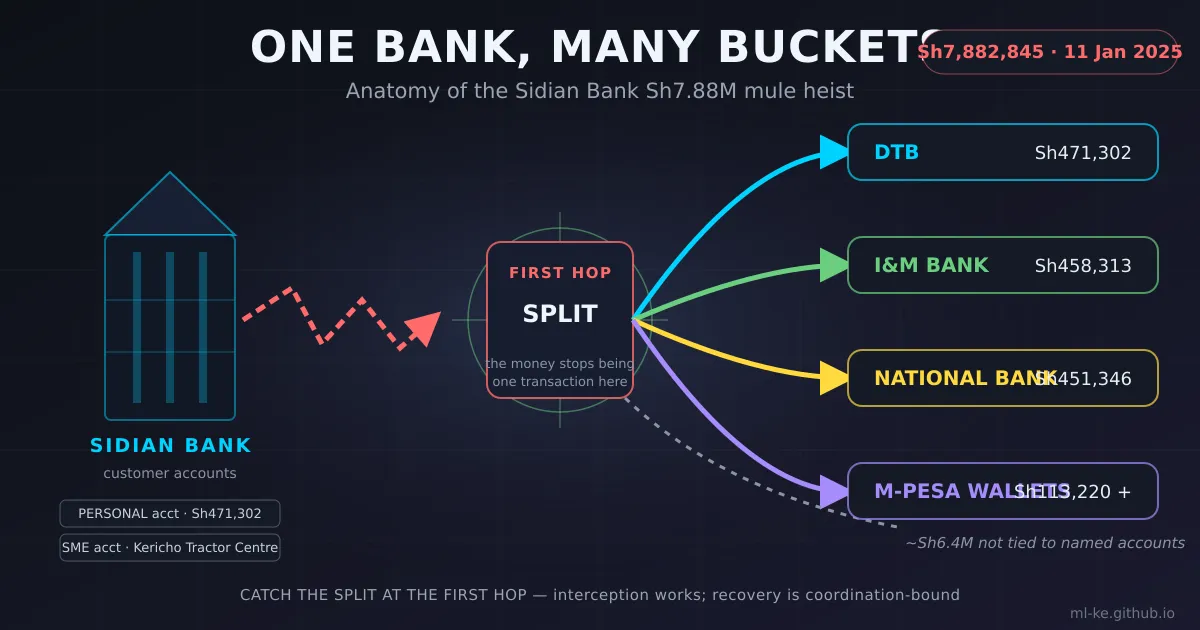
On Saturday, January 11, 2025, someone moved Sh7,882,845 out of customer accounts at Sidian Bank without the customers’ knowledge. By the time the courts saw it, the money had been split across personal bank accounts and M-Pesa wallets held by at least four university and technical-college students — Collins Mutuma (Mount Kenya University), John Oboni Odidi (JKUAT), Phostine Hesbon Ochieng (Thika TTI) and Nelson Christiano Nangole — charged in two waves, on August 25 and October 27, 2025, all pleading not guilty (Tuko, Nairobi Wire).
Why this case matters for fraud engineering The entry vector — how the accounts were accessed — was never publicly established. The dispersal, however, is fully documented in the charge sheets, and that is the part a bank can defend against. This post walks the mule anatomy and the one control that still works after money leaves: the first hop.
What the charge sheets say
Both waves cite the same incident — January 11, 2025, “at an unknown place within the Republic of Kenya.” Mutuma’s conspiracy count reads (Tuko, Bizna Kenya):
“On January 11, 2025, at an unknown place within the Republic of Kenya, jointly with others not before court, you conspired with intent to defraud Sidian Bank of Ksh7,882,845 by unlawfully siphoning funds from various bank accounts domiciled at the said bank.”
Mutuma faced three counts — conspiracy to defraud (Penal Code s.317), stealing (s.268(1) as read with s.275), and acquisition of proceeds of crime (Proceeds of Crime and Anti-Money Laundering Act s.4(a)) — the trio theft, handling stolen property, and laundering proceeds of crime (Bizna Kenya, Education News Kenya). Kenya Insights reported prosecutors calling it one of the most sophisticated cyber thefts by a university student in Kenya, with Mutuma having “bypassed multiple security layers” (Kenya Insights).
The victims named in the counts were ordinary account holders, not corporates — a warning for banks that size fraud risk by balance. Peninah Karoki lost Sh471,302 from her personal account, the sum Mutuma is accused of taking into his Diamond Trust Bank (DTB) account (Kahawatungu); the Sh451,346 leg attributed to Ochieng came out of the Kericho Tractor Centre business account (Nairobi Wire, Education News Kenya). Sidian — the Nairobi SME lender that rebranded from K-Rep Bank in 2016 (Wikipedia) — was hit through the small customers it exists to serve.
What we don’t know No public source documents the mechanism — SIM swap, phishing, leaked credentials, an insider, an application flaw. “Unlawfully siphoning funds from various bank accounts” is the extent of the court record. Treat vector claims as unproven until trial evidence says otherwise; the dispersal pattern needs no such assumption.
The mule anatomy: one theft, many buckets
The charge sheets document where the money went in unusual detail:
| Accused | Destination named in the charge | Amount |
|---|---|---|
| Odidi (JKUAT) | Two I&M Bank accounts under his name | Sh458,313 |
| Ochieng (Thika TTI) | His National Bank and M-Pesa accounts, from the Kericho Tractor Centre account | Sh451,346 |
| Nangole | Retained in his M-Pesa wallet | Sh113,220 |
| Mutuma (MKU) | His DTB account (Karoki’s Sh471,302), then Sh300,000 onward to Dominic Gichiri and ~Sh169,900 to Samuel Mukola Matheka’s M-Pesa wallet | ~Sh941,202 handled |
Sources: Nairobi Wire, Education News Kenya, Bizna Kenya, Kahawatungu.
Read as data, four properties stand out:
- Cross-institution by design. Funds landed in DTB, I&M, National Bank and M-Pesa wallets; after the first hop no single bank could see the whole picture.
- Odd, deliberately sub-threshold amounts. Sh458,313, Sh451,346, Sh471,302, Sh113,220 — none round, all under Sh500,000. Round-number alerting (“flag above Sh1M”) never blinks.
- Named legs cover under a fifth of the pot. 458,313 + 451,346 + 471,302 + 113,220 = Sh1,494,181 — ~19% of Sh7,882,845. The remaining ~Sh6.4M sat in accounts no named defendant was tied to when these charges were filed.
- A visible pass-through structure. Mutuma is accused of receiving Karoki’s Sh471,302 and moving ~Sh469,900 of it onward (Kenya Insights, Kahawatungu) — the signature of a mule layer that never holds money, only passes it through.
Whether the students were knowing mules or principals is for the court. In AML terms the shape is textbook money-mule dispersal: a large unauthorized transfer, broken into odd sub-threshold pieces, moved through freshly-used personal accounts and wallets, pushed onward before detection can freeze the first destination.
Why the first hop is the only reliable control
Fraud controls have a harsh asymmetry. The victim bank can monitor its own outbound payments in real time; the moment money lands in another institution’s ledger or a wallet, recovery depends on cross-bank coordination and freezing orders that move slower than the money. The CBK’s 2024 numbers quantify it: banking-sector fraud losses grew 3.9× year-on-year while recoveries grew only 1.4×, and the loss-to-exposure conversion hit 81% (CBK Financial Sector Stability Report 2024, analysed in Fraud Went Mobile).
The interception point, then, is the first hop — the moment an ordinary account suddenly fans out odd-sized payments to wallets and accounts it has never paid. That is the one moment the data is still inside the bank’s own walls. The demo encodes the pattern as a runnable heuristic.
1
2
3
4
5
6
7
8
9
10
11
12
13
14
15
16
17
18
19
20
21
22
23
24
25
26
27
28
29
30
31
32
33
34
35
36
37
38
# First-hop fan-out heuristic — illustrative, mirrors the documented Sidian
# pattern (one event, same-window dispersal, odd sub-500k legs, wallets).
# Rows: (payer, beneficiary, amount, minute_of_day, channel)
batch = [
    ("P. Karoki",      "C. Mutuma - DTB",    471302, 341, "bank"),
    ("C. Mutuma",      "D. Gichiri",         300000, 343, "bank"),
    ("C. Mutuma",      "S. Matheka - MPESA", 169900, 344, "wallet"),
    ("Kericho Tractor","P. Ochieng - NB",    451346, 342, "bank"),
    ("P. Ochieng",     "own MPESA",           90000, 348, "wallet"),
    ("J. Odidi",       "I&M acct 2",         458313, 341, "bank"),
    ("Acct 9041",      "N. Nangole - MPESA", 113220, 342, "wallet"),
    ("Acct 3317",      "rent-payee",          42000, 350, "bank"),
    ("Acct 3317",      "supplier A",         180000, 390, "bank"),
    ("Acct 8842",      "school-fees",         95000, 375, "bank"),
]

def flag(batch):
    hits = []
    for payer, ben, amt, minute, ch in batch:
        reasons = []
        same_min = [r for r in batch
                    if r[0] == payer and abs(r[3] - minute) <= 3]
        # 1) fan-out: payer sends 2+ payments within a 3-minute window
        if len(same_min) >= 2:
            reasons.append(f"fan-out: {len(same_min)} payments in {max(r[3] for r in same_min) - min(r[3] for r in same_min) + 1} min")
        # 2) pass-through: payer also RECEIVED a large inbound earlier
        inbound = [r for r in batch if r[1].split(" - ")[0] == payer]
        if inbound and amt < inbound[0][2]:
            reasons.append("pass-through: pays out after receiving")
        # 3) odd, sub-500k amount to a wallet
        if ch == "wallet" and amt < 500_000 and amt % 1000 != 0:
            reasons.append("odd sub-500k wallet credit")
        if reasons:
            hits.append((payer, ben, amt, reasons))
    return hits

for payer, ben, amt, reasons in flag(batch):
    print(f"FLAG  {payer:15s} -> {ben:18s} KSh {amt:>7,}  {'; '.join(reasons)}")
1
2
3
4
FLAG  C. Mutuma       -> D. Gichiri         KSh 300,000  fan-out: 2 payments in 2 min; pass-through: pays out after receiving
FLAG  C. Mutuma       -> S. Matheka - MPESA KSh 169,900  fan-out: 2 payments in 2 min; pass-through: pays out after receiving; odd sub-500k wallet credit
FLAG  P. Ochieng      -> own MPESA          KSh  90,000  pass-through: pays out after receiving
FLAG  Acct 9041       -> N. Nangole - MPESA KSh 113,220  odd sub-500k wallet credit
The heuristic fires on the pass-through layer — Mutuma’s onward pair, Ochieng’s wallet move, Nangole’s wallet credit — and on none of the legitimate rows (rent, supplier, fees). Read the misses too: the plain bank-to-bank first hops (Karoki to DTB, Odidi to I&M) are odd-sized but don’t fan out or touch a wallet, so a fan-out rule alone walks past them. Production closes that gap with a new-beneficiary rule — the payer had never sent there before — which is why receiving-side history matters as much as sending-side velocity (Fraud Model Drift Monitoring). And a flag is a screener, not a verdict: the value is queue priority for human review and a freeze while the first destination still holds a balance.
How we can do better
- Monitor fan-out, not just size. Alert on payers with 2+ outbound payments to new beneficiaries inside a short window, whatever the amount — every Sidian leg was under Sh500,000.
- Score the first destination, not just the source. A wallet or account with no six-figure history receiving odd amounts minutes after a large credit is a mule signature.
- Hold-and-verify on pass-through. On receive-then-split-within-minutes, hold or step-up the outbound leg. Reversal machinery is what separated card fraud (banks claw back ~40%) from channels that lost 81% of exposure (Fraud Went Mobile).
- Treat wallets as first-class beneficiaries. ~Sh283,000 of documented legs passed through M-Pesa wallets; score wallet credits from cold accounts like interbank transfers.
- Share the pattern cross-bank. No single institution sees Odidi’s I&M accounts, Ochieng’s National Bank account and Matheka’s wallet in one view; sector data-sharing and fast FRC reporting enable the second-hop freeze (The Middleman Problem).
- Design for the limitation. Past the first hop, recovery is coordination-bound and slow — which is why detection latency, not detection sophistication, is the metric that matters. NCBA’s eight-day blind spot until end-of-week reconciliation is the cautionary tale (The NCBA Sh57.5M Ghost Account Fraud).
Key takeaways
| Lesson | Why |
|---|---|
| The dispersal is the crime’s weak point | One bank’s data covers hop one; after that the money is spread across institutions and wallets |
| Odd sub-threshold amounts evade size rules | Sh458,313 is nobody’s round number; monitor structure, not magnitude |
| Pass-through accounts are the tell | Receive-then-split-within-minutes is a mule signature, not spending |
| First-hop speed beats recovery | CBK 2024: losses ×3.9, recoveries ×1.4 — intercept while the money is inside your walls |
| The charge sheet is not the full story | ~19% of the Sh7.88M is tied to named accounts; vector and the bulk of funds remain under investigation |
References
- Tuko — MKU Student Charged with Hacking Sidian Bank, Stealing KSh 7.8 Million (Oct 28, 2025)
- Bizna Kenya — How MKU student hacked Sidian Bank, stole Sh7.8 million (Oct 28, 2025)
- Kenya Insights — How a 20-year-old university student breached Sidian Bank’s security fortress (Oct 31, 2025)
- Kahawatungu — University student in court for Sh7.8 million fraud at Sidian Bank (Oct 27, 2025)
- Nairobi Wire — 3 Students in Court over Alleged Sh7.8m Sidian Bank Account Theft (Aug 26, 2025)
- Education News Kenya — Three varsity students charged over Shs 7.8M theft at Sidian Bank (Aug 25, 2025)
- CBK — Financial Sector Stability Report 2024 (Table 14)
- Wikipedia — Sidian Bank