Paging the Ledger: Real-Time Reconciliation Alerting That Actually Wakes Someone
The break has a clock, and it is not yours
On 20 September 2019 the Reserve Bank of India redefined what a reconciliation break is. Under its harmonised TAT framework (in force 15 October 2019), if a customer is debited but the beneficiary is not credited, the beneficiary bank must auto-reverse by T+1 — T+5 for merchant payments — or pay ₹100 per day per transaction, credited “suo moto, without waiting for a complaint or claim from the customer” (RBI).
A customer-visible failure, a statutory deadline, a per-transaction penalty — and the customer removed from the detection loop: no ticket, no complaint, no error code tells you money is stuck. Only your reconciliation queue can find it, and only if that queue is paged inside the clock.
Reconciliation analytics, anomaly detection and outage post-mortems already cover the detectors and the measurement. This post is the piece between them: money SLIs, burn-rate alerting, dedup, the page budget, the runbook, and the forced sweep after a restart.
Integrity alerts are a different species
SRE’s oldest rule is to alert on symptoms, not causes. In payments the symptom is money whose state is unknown — not “detector 7 fired”.
A detector firing is a cause. rules_engine_consumer_lag_high leaves the on-call engineer to work out whether money is affected; “KES 1.4M unmatched, oldest 3h 10m” tells them who to call.
Integrity budgets are timing budgets. Unmatched value is money whose status is unknown; most clears when the partner feed catches up and only a fraction monetises. Say so in the alert doc, or “24× burn” reads as a loss.
Silence is the dangerous failure. NCBA Bank Rwanda’s injected logic returned success for every withdrawal, suppressing the error signals monitoring watched (analysed here). Mobile money repeats the shape for a duller reason: Daraja callbacks are HTTPS POSTs and Daraja refuses HTTP callback URLs, so a misconfigured endpoint stops delivering without erroring (KenZobe).
Define money SLIs before you write a single alert
You cannot page on what you have not named. Six SLIs cover most payments stacks:
| SLI | Definition | Example objective | Route |
|---|---|---|---|
unmatched_value | KES of items posted but not matched, now | ≤ 0.1% of settled value / 30 d | burn-rate page |
match_latency_p95 | posting → matched, 95th percentile | ≤ 15 min intraday | page at 3× objective |
break_age_max | age of the oldest break with no owner | ≤ 4 h | page the owner |
auto_match_rate | lines matched without a human | ≥ 99.5% | ticket |
clock_margin | hours before the statutory reversal deadline | ≥ 6 h | page |
silent_channel | minutes since an always-breaking channel produced none | ≤ 90 min | investigate |
Two rules make the table real. Set every objective strictly inside the statutory clock — a rule firing at T+0.9 of a T+1 deadline leaves a two-hour window at 02:00. And treat clock_margin as the countdown to automatic compensation: the SLI that makes a queue financial rather than technical.
Burn rate, in shillings
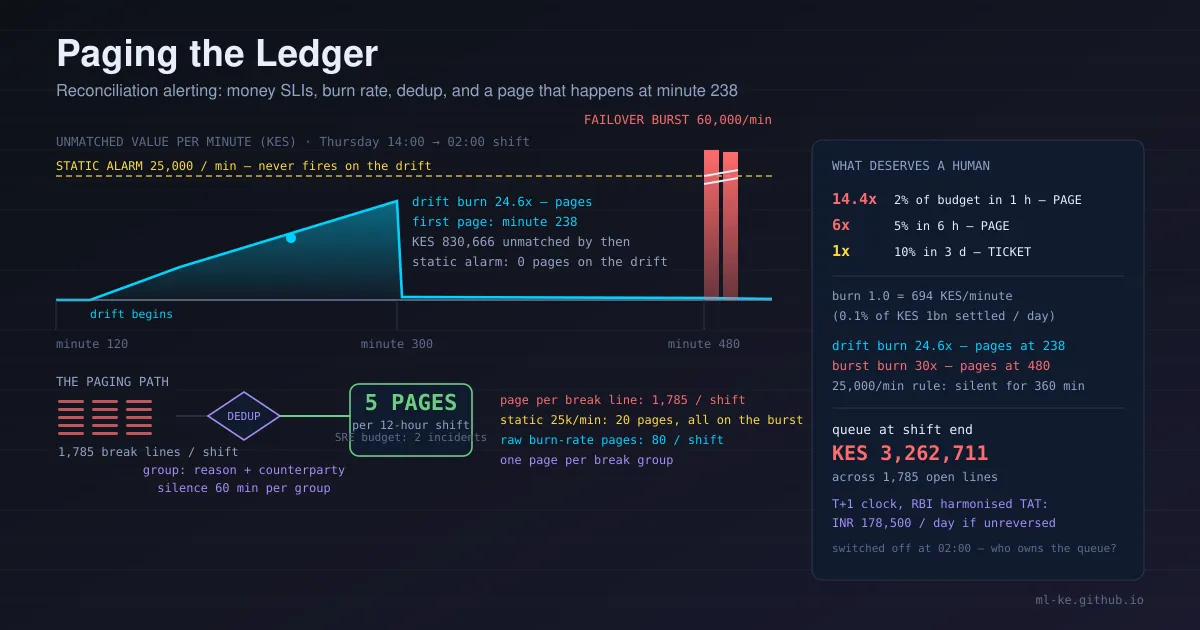
The SRE Workbook’s construction — alert on how fast the budget burns, across several windows (SRE Workbook) — survives the change of unit: 2% of budget in 1 hour (burn rate 14.4) and 5% in 6 hours (6) page, 10% in 3 days (1) opens a ticket. Set the SLI at unmatched value ≤ 0.1% of settled value over 30 days and a KES 1bn/day base makes burn rate 1.0 equal KES 694 per minute. The Workbook also warns that with three windows configured one bad minute satisfies all three, and suggests a short confirmation window 1/12 the long one:
1
2
3
4
5
6
7
- alert: reconciliation_budget_burn
  expr: sli_unmatched_value_rate_1h > 14.4 * 0.0001
        and sli_unmatched_value_rate_5m > 14.4 * 0.0001
  labels: {severity: page, runbook: runbooks/unmatched-value.md}
- alert: reconciliation_budget_burn_slow
  expr: sli_unmatched_value_rate_3d > 1 * 0.0001
  labels: {severity: ticket}
graph LR
    A[break events<br/>1,785 per shift] --> B[aggregate by reason<br/>+ counterparty]
    B --> C{burn over 14.4x<br/>1h window, 5m confirm}
    C -->|yes| D[page on-call<br/>with runbook link]
    C -->|no| E[queue for the<br/>next business day]
The page budget: why per-break paging always fails
The SRE Book caps on-call load: one incident — root cause, remediation, postmortem, follow-ups — averages about 6 hours, limiting a healthy rotation to 2 incidents per 12-hour shift, median 0 (SRE Book). Alerting that ignores that ceiling trains people to ignore alerts.
The demo below runs 720 one-minute bins of a break queue: a slow drift from minute 120 (a partner feed falling behind, climbing to KES 20,000/min) and a failover burst at minute 480. Four policies, same data:
| Policy | Pages per shift | First page | What it misses |
|---|---|---|---|
| A — page every break line | 1,785 (one every 24.2 s) | everywhere | everything |
| B — static alarm at 25,000/min | 20 | minute 480 | the 360-min drift |
| C — burn rate 14.4× (1h + 5m) | 80 | minute 238 | nothing — it never stops firing |
| D — burn rate + group + 60-min silence | 5 | minute 238 | nothing it should |
Policy B is what most finance shops run: plausible, and structurally blind to the drift that partner reconciliation problems actually produce. Policy C catches that drift two hours in — KES 830,666 already unmatched — but 80 pages is four times the shift’s budget; Policy D, the same trigger with grouping, lands at 5.
What the table does not contain is a false-positive rate: alert fatigue in finance is an ownership problem before a maths problem.
The runbook is the deliverable
An alert without a runbook is a notification. Write the first actions and the clock against each route:
| Signal | Owner | First actions | Clock |
|---|---|---|---|
| burn > 14.4× | payments on-call | freeze auto-close; compare ledger to switch control totals; call the counterparty | minutes |
| burn > 6× for 6 h | reconciliation engineer | isolate reason codes; quantify KES and count; decide customer-visible vs internal | hours |
| burn > 1× for 3 d | queue owner | split the backlog by counterparty; stop the process creating it | next business day |
break_age_max > 4 h, no owner | queue owner | assign, or escalate that the queue has no owner | hours |
silent_channel | integration on-call | check callback reachability and TLS; reconcile by polling status, not waiting | 90 min |
clock_margin < 6 h | payments lead | prioritise the affected set; start auto-reversal; confirm the compensation path | statutory |
Three rules outrank the table: never auto-close a break to clear a dashboard (that is how a queue becomes a lie); a suppression is not a resolution; and every page must reach someone who can act.
The forced sweep after a restart
Restarts manufacture reconciliation debt. When an issuer goes offline the network can authorise on its behalf: Visa’s stand-in processing does this, and the AI version shipped in August 2020 approves or declines using cardholder-level deep learning, claiming up to 50% fewer declines (Visa). Each is an authorisation your ledger never made, arriving only with clearing. Instant rails are worse: the EPC’s SCT Inst rulebook records the EU Instant Payments Regulation shortening the hard timeline to 10 seconds, which is why transaction timestamps must now carry milliseconds (EPC). At ten seconds a timeout is not an edge case; it is a queue item you inherit.
So the sweep has a shape, and it is not “reconcile harder”:
- Cut off at a point of financial reference — the last confirmed settlement position, not a deploy timestamp.
- Replay with an idempotency key on every message, so duplicates are suppressible rather than debatable.
- Bucket into three: matched, unmatched, duplicate-suppressed. The third is where retry surges hide.
- Sweep before the clock, not after — “restored” is a status, not a reconciliation (TechCabal on M-Shwari).
The demo
Stdlib Python, no network, seeded: 720 one-minute bins over a KES 1bn/day settled base with a 0.1%/30-day SLI, so burn rate 1.0 is KES 694/minute.
1
2
3
4
5
6
7
8
9
10
11
12
13
14
15
16
17
18
19
20
21
22
23
24
25
26
27
28
29
30
31
32
33
34
35
36
37
38
39
40
41
42
43
44
45
46
47
48
49
50
51
52
53
54
55
56
57
58
59
60
61
62
63
64
65
66
67
68
69
70
71
72
73
74
75
76
77
78
79
80
81
82
83
84
85
86
87
88
89
90
"""Alerting pipeline for a payments reconciliation queue - stdlib only, deterministic.

12-hour on-call shift, 1-minute bins. Break events carry a value in KES.
Budget: daily settled value KES 1,000,000,000; SLI = unmatched value <= 0.1% of
settled value over 30 days  ->  error budget KES 30,000,000 / 30 days
= KES 1,000,000/day = KES 694.44/min == burn rate 1.0.
"""
import random

random.seed(13)
MINUTES = 720
SETTLED_PER_DAY = 1_000_000_000
SLO_ERROR_RATIO = 0.001                        # 99.9%
BUDGET_PER_MIN = SETTLED_PER_DAY * SLO_ERROR_RATIO / 1440    # 694.4 KES/min
STATIC_LIMIT = 25_000                          # ops team's "suspicious minute" limit

def minute_slice(minute):
    """(n_lines, total_value) of unmatched items posted in this minute."""
    ramp = 0.0
    extra_lines = 0
    if 120 <= minute < 300:                    # slow drift: partner feed lag builds
        ramp = 20_000 * (minute - 120) / 180
        extra_lines = 1
    if 480 <= minute < 500:                    # switch failover: hard burst
        ramp += 60_000
        extra_lines += 8
    n = random.randint(0, 4) + extra_lines
    base = sum(max(0.0, random.gauss(150, 60)) for _ in range(n))
    return n, base + ramp

def reason_for(minute):
    if 480 <= minute < 500:
        return "FAILOVER_UNMATCHED"
    if 120 <= minute < 300:
        return "PARTNER_FEED_LAG"
    return "TIMEOUT_STALE_STATUS"

bins = [(m,) + minute_slice(m) for m in range(MINUTES)]

def burn(window, end, level=0.0):
    """Burn rate: unmatched value in the trailing window / budget for that window."""
    lo = max(0, end - window)
    spent = sum(v for _, _, v in bins[lo:end]) + level
    return spent / (BUDGET_PER_MIN * window)

# Policy A - page on every break line
pages_a = sum(n for _, n, _ in bins)

# Policy B - static threshold on the value posted in a minute
pages_b, first_b = 0, None
for m, _, v in bins:
    if v > STATIC_LIMIT:
        pages_b += 1
        first_b = m if first_b is None else first_b

# Policy C - multiwindow, multi-burn-rate (Workbook Table 5-6: 14.4x/1h, 6x/6h)
pages_c, first_c = 0, None
for m in range(1, MINUTES):
    if burn(60, m) > 14.4 and burn(5, m) > 14.4:
        pages_c += 1
        first_c = m if first_c is None else first_c

# Policy D - same trigger, plus the grouping/silence the Workbook says you need
pages_d, first_d, silenced_until = 0, None, {}
for m in range(1, MINUTES):
    if burn(60, m) > 14.4 and burn(5, m) > 14.4:
        group = reason_for(m)
        if m >= silenced_until.get(group, 0):
            pages_d += 1
            first_d = m if first_d is None else first_d
            silenced_until[group] = m + 60          # page once per group per hour

queue = sum(v for _, _, v in bins)
open_lines = sum(n for _, n, _ in bins)
drift_value_at = lambda m: sum(v for _, _, v in bins[120:m + 1])

print("shift 720 min | budget %.1f KES/min == burn 1.0" % BUDGET_PER_MIN)
print("unmatched value left in the queue: KES", format(queue, ",.0f"))
print("open break lines: %d" % open_lines)
print("drift burn at minute 300 (1h window): %.1fx" % burn(60, 300))
print("burst burn at minute 500 (1h window): %.0fx" % burn(60, 500))
print("A page-per-break      : %d pages/shift (one every %.1f s)" % (pages_a, 43200.0/pages_a))
print("B static 25k/minute   : %d pages/shift, first page %s" %
      (pages_b, ("minute %d" % first_b) if first_b else "NEVER"))
print("C burn-rate, raw      : %d pages/shift, first page minute %d" % (pages_c, first_c))
print("D burn-rate + grouping: %d pages/shift, first page minute %d" % (pages_d, first_d))
print("drift started minute 120; value unmatched before first page: KES",
      format(drift_value_at(first_d), ",.0f") if first_c else "-")
print("statutory exposure if the queue is left past T+1: INR %s/day (%d x 100)" %
      (format(open_lines * 100, ","), open_lines))
Output, verbatim:
1
2
3
4
5
6
7
8
9
10
11
shift 720 min | budget 694.4 KES/min == burn 1.0
unmatched value left in the queue: KES 3,262,711
open break lines: 1785
drift burn at minute 300 (1h window): 24.6x
burst burn at minute 500 (1h window): 30x
A page-per-break      : 1785 pages/shift (one every 24.2 s)
B static 25k/minute   : 20 pages/shift, first page minute 480
C burn-rate, raw      : 80 pages/shift, first page minute 238
D burn-rate + grouping: 5 pages/shift, first page minute 238
drift started minute 120; value unmatched before first page: KES 830,666
statutory exposure if the queue is left past T+1: INR 178,500/day (1785 x 100)
The last line deserves a risk committee: leaving the shift’s queue unreversed past T+1 is ₹178,500 per day of statutory compensation. Seeds 7 and 42 move the numbers by a rounding error; the lesson does not move.
How we can do better
- Name the SLIs and their owners before touching a detector.
- Set objectives inside the statutory clock, with
clock_marginas the countdown. - Page on aggregate value and age, never per line — 1,785 pages is one every 24 seconds.
- One page per break group, runbook link in the payload; the group key is your dedup contract.
- Measure pages per shift against the 2-incident budget, and treat a sustained breach as an incident of its own.
- Alert on silence, and never auto-close a break to clear a dashboard.
- Sweep before the clock — compensation is automatic; your detection does not get to be.
Key takeaways
| Takeaway | Why it matters |
|---|---|
| A break is a liability with a deadline | T+1 pays ₹100/day per unreversed transaction suo moto — detection is mandatory, not best effort |
| Threshold alarms are blind to drift | The 25,000/min rule missed 360 minutes of accumulating unmatched value; it fired only on the burst |
| Burn rate is the right trigger, grouping the right volume | 14.4× caught the drift at minute 238; grouping cut 80 raw pages to 5 |
| On-call has a budget | ~6 hours per incident caps a shift at 2; stand-in authorisations and instant-rail timeouts land in your ledger later, so sweep at a point of financial reference with idempotency keys |
References
- RBI, Harmonisation of TAT and customer compensation for failed transactions, 20 Sep 2019 — rbi.org.in
- Google SRE Workbook, Alerting on SLOs (burn rates 14.4 / 6 / 1) — sre.google
- Google SRE Book, Being On-Call (6 h per incident; 2 per shift) — sre.google
- Visa, Smarter Stand-in Processing, 26 Aug 2020 — usa.visa.com
- European Payments Council, SCT Inst rulebook (10-second timeline; millisecond timestamps) — europeanpaymentscouncil.eu
- KenZobe, M-PESA Daraja API errors (callback URL requirements) — kenzobe.com
- TechCabal, NCBA works to restore M-Shwari outage, 3 Nov 2025 — techcabal.com