The Bottleneck Is Adoption, Not Innovation: Reading Nigeria's AI Maternal Health Multiplier
Introduction
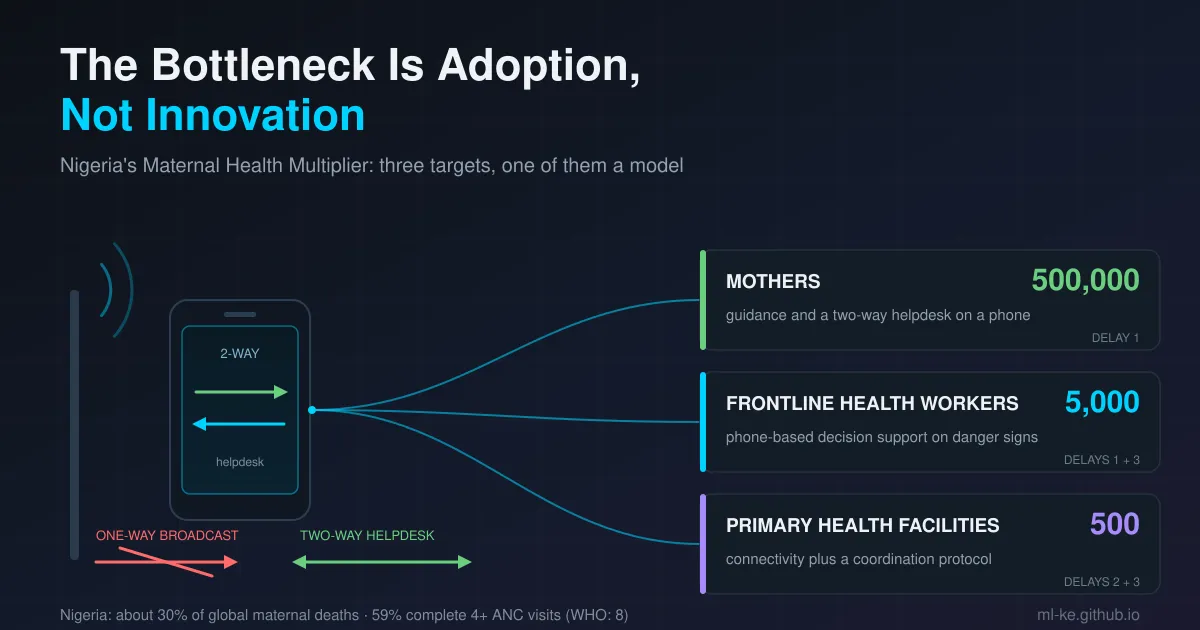
The release, in one line On 22 September 2026 the Gates Foundation and the MTN Group Foundation announced the Nigeria Maternal Health Multiplier: four years, roughly US$25 million, and three targets for 2030: 500,000 women reached with health guidance, 5,000 frontline health workers given phone-based decision support, and 500 primary health care facilities connected.
Three targets, and only one is a model. The other two are a device-distribution business and a civil-works problem, the part most coverage skipped on the way to “AI-enabled”. What follows is the arithmetic: the burden numbers behind the release, the two evaluated East African analogues, and what those targets imply per worker and per facility. Nigeria is the first market, not a pilot, and MTN says the ambition is continental.
What was announced
The partnership was released at Semafor’s Next 3 Billion event on the sidelines of the 81st United Nations General Assembly in New York on 22 September (MTN’s release carries a 23 September dateline; Fortune reported the four-year, $25 million structure the same day, and Business AM Live places it on the UNGA sidelines). The commitment runs 2026 to 2030, blends direct and in-kind contributions, and is an anchor investment meant to catalyse additional funding rather than fund the programme alone.
The vehicle is an “integrated digital ecosystem” connecting women, frontline health workers and primary health care facilities, built from three components: AI-enabled phone-based decision support for workers and mothers, affordable smartphones and mobile data, and improved connectivity at facilities. Nigeria is first; MTN Group CEO Ralph Mupita framed the ambition as demonstrating “a scalable model for improving maternal and child health outcomes across Africa”.
It does not stand alone. The Multiplier complements Nigeria’s Maternal and Neonatal Mortality Reduction Innovation Initiative (MAMII), launched in November 2024 as a Gates-funded, midwifery-led programme now spanning 33 states, with the Federal Ministry of Health expecting around 2.9 million pregnant women to benefit across 172 local government areas; the Liverpool School of Tropical Medicine is running its independent evaluation, and in September 2026 the ministry flagged off service-utilisation incentives inside MAMII.
Two quotes in the release point away from the technology:
“For too long, the biggest barrier to improving service delivery in Nigeria, whether in health, agriculture, or education, has not been a lack of innovations, but a lack of focus on the foundational systems necessary to drive adoption.” — Dr. Bosun Tijani, Nigeria’s Minister of Communications, Innovation and Digital Economy
“Partnerships that work with our existing health systems, rather than around them, are exactly what’s needed to reach mothers who are still falling through the cracks.” — Dr. Muhammad Ali Pate, Nigeria’s Coordinating Minister of Health and Social Welfare
Read those as the problem statement. The bet is not that a better triage model changes maternal outcomes; it is that devices, data and a two-way helpdesk are the missing layer on top of a system that already contains MAMII.
The burden numbers survive checking
Announcement figures need two passes: verify the number, then check who owns it.
Nigeria’s share of global maternal deaths is the headline. The release says “nearly 30% of all maternal deaths worldwide”. The BBC, working from the most recent UN estimates compiled from 2023 figures, puts it at well over a quarter (29%) of all maternal deaths worldwide: an estimated 75,000 women a year, one death every seven minutes, and a lifetime risk of about one in a hundred. Two independent passes, same order of magnitude.
The release’s comparative claim (sub-Saharan African risk “roughly 250 times higher than in Western Europe”) is the announcement’s own framing of lifetime risk, not a ratio of maternal mortality ratios. Cite it as such, and quote a rate when a rate is needed: the WHO Africa region bands Nigeria above 1,000 deaths per 100,000 live births, against an SDG target of 70.
The utilisation number explains why a phone tool is the chosen intervention. Only 59% of Nigerian women complete four or more antenatal care visits, and that is not the current standard: WHO’s 2016 guideline recommends a minimum of eight contacts to reduce perinatal mortality. The programme enters a system where two in five women miss even the older, lower threshold, and where the BBC’s reporting finds 121,000 midwives for a population of 218 million, under half of births attended by a skilled worker, and health spending at 5% of the federal budget against the 15% Abuja Declaration target.
One level up: the platform is phone-based, and GSMA’s Mobile Economy Africa 2026 reports that almost 1 billion people in Africa (63% of the population) are not using mobile internet despite living under coverage, naming device affordability, digital skills and relevant content as the barriers. That is why “affordable smartphones and mobile data” is a component and not a footnote: a tool that assumes a data connection serves the 37%.
Three components, three delays
The three delays model (Thaddeus & Maine, 1994) makes the design legible: deciding to seek care, reaching care, receiving adequate care.
| Component | Delay it attacks | What it cannot fix | Known failure mode |
|---|---|---|---|
| AI-enabled phone-based decision support (workers + mothers) | Delay 1 (deciding) and Delay 3 (quality of care received) | Transport, staffing, blood supply, facility readiness | Alert fatigue when escalation is set by recall rather than by a worker’s actionable budget |
| Affordable smartphones and mobile data | Delay 1, by removing cost as the reason not to use the tool | Coverage gaps and electricity | Enrolment without engagement; device schemes that end when the subsidy does |
| Connectivity at primary health care facilities | Delay 2 (reaching care) and Delay 3, by letting a facility prepare | Roads, vehicles, referral transport | Connectivity without a coordination protocol — the receiving facility still learns of the emergency on arrival |
That last row is not hypothetical. In Tanzania’s m-mama programme, the scaling evaluation identified the coordination protocol as the load-bearing part: a 24-hour toll-free line, a dispatch centre, and a call ahead so the receiving facility is told what is coming and can prepare (BMJ Open, 2024). Connectivity is the precondition; the protocol is the intervention.
What the evidence already says, and where it says no
Two evaluated East African analogues are close enough to be informative, and reading them honestly is the difference between a useful post and a press-release rewrite.
Kenya: PROMPTS. Jacaranda Health’s platform (informational SMS, appointment reminders and a two-way clinical helpdesk) is the closest published cousin to the “decision support for mothers” component. It was evaluated in a cluster randomised controlled trial across 40 health facilities in 8 Kenyan counties with 6,139 consented participants (PLOS Medicine, full text via PMC). Intention-to-treat effects, as standardised indices:
| Domain | Effect (ITT) | 95% CI | p |
|---|---|---|---|
| Knowledge | +0.08 SD | 0.03 – 0.12 | 0.002 |
| Birth preparedness | +0.08 SD | 0.02 – 0.13 | 0.018 |
| Routine care seeking | +0.07 SD | 0.03 – 0.11 | 0.003 |
| Newborn care | +0.09 SD | 0.07 – 0.12 | <0.001 |
| Postpartum care content | +0.06 SD | 0.01 – 0.12 | 0.043 |
| Danger-sign care seeking | no significant effect | −0.01 – 0.08 | 0.096 |
Three things matter more than the headline “it works”. The effects are small per domain but directionally consistent, and the authors argue the scale makes them clinically meaningful: roughly a 20% rise in the share of women receiving the nationally recommended quantity of postpartum visits, and over a 10% increase in family planning counselling and physical examinations. The domain named as a priority, recognising and acting on danger signs, did not move. And the outcomes were self-reported, with the trial “not powered to detect effects on health outcomes”, so nobody measured whether mothers lived.
The cost figure is the one to remember: 74 US cents per participant for their lifetime on the platform, including message delivery, infrastructure, field enrolment and county engagement (at over 750,000 enrolled when the study began and more than two million since). An automated messaging and helpdesk layer costs cents; devices and connectivity cost dollars. That asymmetry is why the other two components exist, and why 74 cents is the wrong yardstick for a $50-per-woman programme.
Tanzania: m-mama. A transport intervention addressing Delay 2 rather than Delay 1. Across 989 completed referrals in Shinyanga, 69.9% used the community system and 30.1% the standard ambulance, at US$170.40 per completed referral against US$472 by ambulance alone (PLOS Global Public Health, 2023). The mechanism is coordination plus reimbursement, not prediction.
And the caution. WHO’s guideline on digital interventions for health system strengthening states plainly that “digital health interventions are not a substitute for functioning health systems, and that there are significant limitations to what digital health is able to address”. Pate’s “with our existing health systems, rather than around them” is the same sentence in ministerial language.
The honest read In the closest published RCT of a comparable intervention, maternal mortality was never measured. Phone-based support moved knowledge, preparedness and care-seeking by a tenth of a standard deviation, missed the danger-sign domain, and cost 74 cents per woman. That is a real, positive result. It is not evidence that a decision-support model changes whether mothers die, and no credible case study will exist for the Multiplier until someone designs a study that can detect it.
Read the targets like an engineer
Divide the programme’s own numbers and the shape of the operational problem appears.
1
2
3
4
5
6
7
8
9
10
11
12
13
14
WOMEN, WORKERS, FACILITIES = 500_000, 5_000, 500
BUDGET_USD, YEARS = 25_000_000, 4

print(f"women per frontline worker : {WOMEN / WORKERS:>10,.0f}")
print(f"women per facility         : {WOMEN / FACILITIES:>10,.0f}")
print(f"facilities per worker      : {FACILITIES / WORKERS:>10,.2f}")
print(f"anchor spend per woman     : {BUDGET_USD / WOMEN:>10,.2f} USD")
print(f"anchor spend per woman-year: {BUDGET_USD / WOMEN / YEARS:>10,.2f} USD")
print()
print("what the same $25M anchor implies at different realised reach")
print(f"{'reached':>8} {'women':>9} {'USD/woman':>10} {'x PROMPTS 0.74':>16}")
for r in (1.00, 0.80, 0.60, 0.40):
    women = WOMEN * r
    print(f"{r:>8.0%} {women:>9,.0f} {BUDGET_USD / women:>10,.2f} {BUDGET_USD / women / 0.74:>15,.1f}x")
1
2
3
4
5
6
7
8
9
10
11
12
women per frontline worker :        100
women per facility         :      1,000
facilities per worker      :       0.10
anchor spend per woman     :      50.00 USD
anchor spend per woman-year:      12.50 USD

what the same $25M anchor implies at different realised reach
 reached     women  USD/woman   x PROMPTS 0.74
    100%   500,000      50.00            67.6x
     80%   400,000      62.50            84.5x
     60%   300,000      83.33           112.6x
     40%   200,000     125.00           168.9x
Two readings follow. The caseload is small at the worker level: 100 women per frontline worker is a supervisable number, not a queue-sized one, which is what makes a human in the loop plausible rather than decorative. At that scale it is worth calibrating the model’s output before anyone sets a threshold on it, because you can afford to be wrong in the recoverable direction and route the rest to a person.
The second: $50 per woman is 67.6× the PROMPTS per-participant cost, and that gap is the honest content of the announcement, the price of the devices, the data and the facility links. The multiplication rows matter because “aims to help 500,000 women” is a target, not a confirmation; at 60% realised reach the same anchor implies $83.33 per woman. Treat it as a constraint the programme has to defend, not an outcome.
Where the AI has to earn its place
The component labelled “AI-enabled” gets one clean test: it must reduce harm per alert raised, inside the escalation budget a real worker has.
1
2
3
4
5
6
7
8
9
10
11
12
13
14
15
16
17
18
19
20
21
22
23
CASELOAD = 100          # women per frontline worker, from the target arithmetic
PER_WEEK = 1            # scheduled check-ins per woman
WEEKS = 40              # pregnancy plus postnatal window
ACTION_BUDGET = 5       # escalations one worker can genuinely act on per day

contacts = CASELOAD * PER_WEEK * WEEKS
per_day = contacts / (WEEKS * 7)
print(f"scheduled contacts, worker-year : {contacts:,}")
print(f"scheduled contacts, worker-day  : {per_day:.2f}")
print(f"max escalation rate inside {ACTION_BUDGET}/day : {ACTION_BUDGET / per_day:.1%}")
print()

def ppv(sens, spec, prev):
    tp = sens * prev
    fp = (1 - spec) * (1 - prev)
    return tp / (tp + fp)

PREVALENCE = 0.02
print(f"{'sens':>5} {'spec':>5} {'PPV':>7} {'alerts/case':>12} {'false share':>12}")
for sens in (0.90, 0.70):
    for spec in (0.95, 0.90, 0.80):
        p = ppv(sens, spec, PREVALENCE)
        print(f"{sens:>5.0%} {spec:>5.0%} {p:>7.1%} {1 / p:>12.1f} {1 - p:>11.1%}")
1
2
3
4
5
6
7
8
9
10
11
scheduled contacts, worker-year : 4,000
scheduled contacts, worker-day  : 14.29
max escalation rate inside 5/day : 35.0%

 sens  spec     PPV  alerts/case  false share
  90%   95%   26.9%          3.7       73.1%
  90%   90%   15.5%          6.4       84.5%
  90%   80%    8.4%         11.9       91.6%
  70%   95%   22.2%          4.5       77.8%
  70%   90%   12.5%          8.0       87.5%
  70%   80%    6.7%         15.0       93.3%
Three conclusions, none of which require knowing which model was picked.
The action budget binds before recall does. At roughly 14 scheduled contacts per worker per day, a five-escalation daily budget caps the rule at a 35% escalation rate. Sensitivity is the wrong dial: a 90%-sensitive rule firing on 60% of contacts raises more flags per day than one worker can close, and the ones that do get closed are sorted by whatever the tool put on top.
Precision is what the worker experiences. Hunting a complication with 2% prevalence, a rule at 90% sensitivity and 90% specificity yields a positive predictive value of 15.5%: 6.4 alerts per true case, 84.5% of escalations false. At 80% specificity the worker sees 11.9 alerts per true case. The published analogue fits: PROMPTS moved care-seeking by a tenth of a standard deviation while producing no measurable change in danger-sign response, which is what a system whose alerts are mostly noise at population prevalence looks like from the inside.
Prevalence drifts, so the threshold has to travel. The same 90/90 rule scores 26.9% PPV at 5% prevalence and 6.7% at 1%. A threshold learned in a high-risk catchment does not transfer without recalibration, the first thing to re-fit if the programme leaves Nigeria.
How to apply this
If you build or procure phone-based decision support for frontline workers, the release is a design brief rather than a model announcement.
- Set the escalation rate backwards from the action budget. Decide how many flags one worker can close per shift, set the threshold to hit that count, and report the escalation rate alongside the sensitivity. A rule nobody can action has a real-world recall of approximately zero.
- Instrument the domain that fails. PROMPTS improved knowledge and preparedness but not danger-sign care seeking, which its authors named as an area for improvement. Measure each domain separately or you will ship a dashboard that looks green while the important cell is flat.
- Budget the connectivity as well as the inference. The model is the cheap part; devices, data and facility links are the cost centre. A telco’s presence in the partnership is the tell.
- Write the coordination protocol before the alerting rule. m-mama’s evidence is pre-notifying the receiving facility, reimbursing transport and staffing a dispatch line.
- Pick an endpoint you can move. Pre-register severe maternal outcome and near-miss indicators alongside the care-content measures, and state which ones the programme is powered to detect.
- Report engagement next to enrolment. PROMPTS enrolled over 750,000, and its own administrative data suggested roughly three in four actively engaged.
Key takeaways
| Point | What the release says | What to hold onto |
|---|---|---|
| The announcement | $25M over four years for 500,000 women, 5,000 workers, 500 facilities by 2030 | An anchor investment meant to catalyse further funding, not the full programme cost |
| The bottleneck | Tijani: the barrier is adoption, not innovation | Devices, data and connectivity are the two-thirds of the programme that are not a model |
| The burden | Nigeria ~30% of global maternal deaths; 59% of women complete 4+ ANC visits | WHO now recommends 8 contacts; two in five women fall below even the older threshold |
| Closest evidence | PROMPTS RCT in Kenya: +0.06 to +0.09 SD across five domains, no effect on danger signs | Effects are real, small and consistent; maternal mortality was never measured |
| Closest cost evidence | m-mama: $170.40 vs $472 per completed referral; PROMPTS at 74c per participant | Coordination and reimbursement, not prediction, drove both results |
| The arithmetic | 100 women per worker, 1,000 per facility, ~$50 per woman | At 60% realised reach that becomes $83.33 per woman |
| The AI test | Not stated in the release | A 35% escalation ceiling and 15.5% PPV at 90/90 and 2% prevalence, recalibrated per market |
References
- Gates Foundation — Maternal Health Multiplier release — 22 Sep 2026; targets, components, quotes
- MTN Group — Maternal Health Multiplier release — four-year structure, partner roles
- Fortune — Gates Foundation and MTN launch AI maternal health platform — $25M over four years, three components
- Healthwise / Punch — MTN, Gates Foundation launch $25m AI initiative — $25m figure, ministry quotes
- Business AM Live — MTN, Gates commit $25m to AI-driven maternal healthcare — UNGA 81 sidelines
- BBC — Nigeria maternal mortality — 29% of global maternal deaths (2023 UN estimates); workforce and budget context
- WHO — Antenatal care guidelines — minimum eight contacts
- WHO — Digital interventions for health system strengthening — not a substitute for functioning health systems
- GSMA — The Mobile Economy Africa 2026 — 63% usage gap
- Vatsa et al. — Impact evaluation of a digital health platform in Kenya — PLOS Medicine; 40 facilities, 6,139 participants, 74c per participant
- Munishi et al. — Community-based transport system in Shinyanga — 989 referrals; $170.40 vs $472
- Shayo et al. — Scaling up an emergency transportation system — BMJ Open; dispatch centre, pre-notification, reimbursement
- Nigeria Health Watch — MAMII — launched November 2024 under SWAp
- Pharmacy News Nigeria — FG initiative to curb maternal deaths — 172 LGAs, 33 states, ~2.9M women in scope
- Federal Ministry of Health — Incentives for maternal and newborn care utilisation — 14 Sep 2026
- LSTM — MAMII evaluation — independent evaluation
Related posts
- Certified in Europe, Judged at the Health Post — the threshold arithmetic a CE mark leaves to the clinic
- The $1 Billion AI Bet — the funding-side framing this deployment sits inside
- Prequalified: WHO Opens Its Procurement List to AI TB Screening Software — what a buyer can infer from a listing
- Your Model’s 0.9 Is Not a 90% Chance — the calibration step before the PPV table above
- AI for African Healthcare — the wider landscape this programme joins